
The modern manufacturing landscape is defined by a singular, pressing challenge: efficiency. With the persistent skilled labor shortage, rising operational costs, and the relentless demand for faster turnaround times, machine shop owners and production managers are under immense pressure to do more with less. The answer, for most, lies in automation.
However, automation is not a monolith. When it comes to automating Computer Numerical Control (CNC) machining centers, two primary contenders dominate the conversation: Automatic Pallet Changers (APC) and Robotic Part Loading.
Both technologies promise the holy grail of manufacturing: lights-out production, reduced labor dependency, and increased spindle uptime. Yet, they achieve these goals through fundamentally different mechanisms, with distinct cost structures, flexibility profiles, and implementation requirements. Choosing the wrong one can lead to stranded capital and bottlenecks; choosing the right one can revolutionize your shop floor.
In this comprehensive guide, we will deep-dive into the mechanics, advantages, limitations, and ideal use cases for both APC and robotic loading systems. By the end, you will have a clear framework for deciding which automation strategy fits your specific production environment.
Understanding Automatic Pallet Changers (APC)
To understand the value of an APC, we must first look at the traditional machining process. In a standard CNC setup, a machinist loads a raw part into a vise or fixture, closes the door, runs the program, opens the door, removes the finished part, cleans the fixture, and repeats. Every second the spindle is stopped for this exchange is non-cutting time, directly eating into profitability.
An Automatic Pallet Changer eliminates this human intervention by utilizing a dual-pallet system.
How It Works
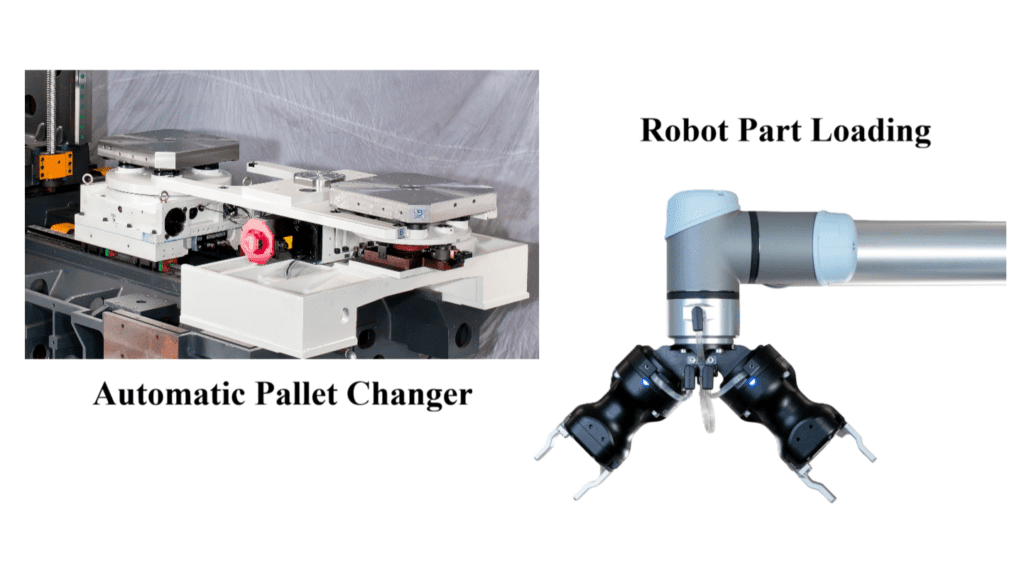
An APC system typically consists of two pallets (or fixtures) that sit on a shuttle mechanism. While the machine is actively machining a part on Pallet A, the operator (or a secondary automation system) can load or unload Pallet B outside the machining envelope. Once the cycle on Pallet A is complete, the machine’s internal mechanism swaps the pallets in a matter of seconds. The spindle never stops for long, and the cutting process resumes almost immediately.
Some advanced APC systems are integrated directly into the machine tool by the OEM (Original Equipment Manufacturer), while others are retrofitted as third-party additions. High-end versions may include a “pallet pool,” allowing for more than two pallets to be queued up, essentially turning a single machine into a small flexible manufacturing system (FMS).
The Strengths of APC
The primary advantage of an APC is rigidity and repeatability. Because the pallets are locked directly into the machine table, they offer the same structural integrity as a manual setup. This is crucial for heavy-cutting applications where vibration or slight movement could ruin tolerances.
Furthermore, APCs are generally faster at swap times than robots. A pallet exchange can happen in 10 to 30 seconds, whereas a robot arm must navigate to the part, grip it, move it out, fetch a new part, and place it. For high-volume production of a single part number, this speed adds up significantly over thousands of cycles.
APCs also tend to have a smaller footprint. Since the mechanism is usually contained within the machine’s existing footprint or extends only slightly to the side, it doesn’t require the safety fencing and floor space that a robotic cell demands.
The Limitations
However, APCs are not without drawbacks. The most significant is inflexibility. An APC is generally designed for a specific fixture or a specific family of parts. If you want to machine a completely different part with a different footprint, you may need to invest in a new pallet and fixture setup, which can be costly and time-consuming to qualify.
Additionally, the capacity is limited. A standard APC holds two pallets. Once those are done, the machine stops unless a human intervenes. While pallet pools exist, they are expensive and complex. Finally, APCs are typically machine-specific. You cannot take an APC from a Haas and move it to a Mazak. It is a dedicated investment for a single asset.
Understanding Robotic Part Loading
Robotic part loading represents a different philosophy of automation. Instead of changing the entire workholding platform (the pallet), a robot manipulates the individual parts into and out of the existing workholding (vise, chuck, or fixture).

The Types of Robots
When discussing CNC loading, we are usually looking at three types of robots:
- Articulated Arm Robots: The classic 6-axis industrial arm (e.g., Fanuc, Yaskawa, KUKA). These offer maximum reach and flexibility, capable of reaching into deep machine envelopes and orienting parts at complex angles.
- Gantry Loaders: These operate on an X-Y-Z rail system above or beside the machine. They are incredibly rigid and fast for linear movements but lack the rotational flexibility of an arm.
- Collaborative Robots (Cobots): Smaller, safer arms (e.g., Universal Robots) designed to work alongside humans without heavy safety fencing. These are gaining traction in smaller job shops due to ease of programming.
How It Works
A robotic cell involves the robot, an end-of-arm tooling (EOAT) gripper, and often a peripheral conveyor or staging area for raw and finished parts. The robot is integrated with the CNC controller via I/O signals. When the machine cycle ends, it sends a signal to the robot. The robot opens the door (if equipped with a door opener), unclamps the vise, removes the finished part, places it on an outfeed, loads a raw part, clamps the vise, closes the door, and signals the cycle to start.
The Strengths of Robotics
The standout feature of robotic loading is flexibility. A robot can be reprogrammed and fitted with new grippers to handle entirely different parts in a matter of hours. This makes it ideal for high-mix, low-volume environments where a shop might run batches of 50 parts today and a different batch tomorrow.
Robots also offer multi-machine tending. A single robust robot arm can be positioned between two or even three CNC machines. While Machine A is cutting, the robot can be loading Machine B. This drastically improves the return on investment (ROI) because one capital expense supports multiple revenue-generating assets.
Furthermore, robots can handle complex material handling. They aren’t limited to just loading the machine; they can also perform secondary operations like deburring, washing, or placing parts onto a CMM (Coordinate Measuring Machine) for inspection within the same cell.
The Limitations
The trade-off for flexibility is complexity and space. A robotic cell requires significant floor space, not just for the arm, but for safety fencing, light curtains, and material staging. Safety is a major consideration; industrial robots move with high force and speed, requiring strict adherence to ISO safety standards to protect human workers.
Cycle time can also be a constraint. While fast, a robot’s pick-and-place cycle is often slower than a pallet swap. Additionally, the robot relies on the machine’s existing workholding. If the vise takes 10 seconds to clamp and unclamp, that time is added to the robot’s cycle, whereas an APC bypasses this by swapping the entire clamped fixture.
Finally, there is the programming hurdle. While cobots have simplified this, industrial robots still require skilled programmers to optimize paths, avoid collisions, and handle error recovery.
Head-to-Head Comparison: APC vs. Robot
To make an informed decision, we need to compare these technologies across critical operational metrics.
1. Initial Investment and ROI
- APC: The cost is often bundled with the machine purchase. A retrofit APC can range from $15,000 to $50,000+ depending on complexity. The ROI is calculated based on the increased uptime of that single machine.
- Robot: A robotic cell (arm, fencing, gripper, integration) can start at $50,000 and easily exceed $150,000. However, because one robot can tend multiple machines, the ROI is calculated across the entire cell. If a $100k robot keeps three $100k machines running lights-out, the ROI is often faster than an APC on a single machine.
2. Flexibility and Changeover
- APC: Low flexibility. Best for dedicated production lines. Changeover requires physical fixture changes and potentially new pallets.
- Robot: High flexibility. Changeover involves program selection and gripper changes. Ideal for job shops with varying part geometries.
3. Floor Space and Footprint
- APC: Minimal impact. Fits within the machine’s footprint.
- Robot: Significant impact. Requires safety zones, material conveyors, and maintenance access. A robotic cell can double the footprint of a single machine setup.
4. Part Weight and Size
- APC: Superior for heavy parts. Pallets can support thousands of pounds because they rest on the machine table.
- Robot: Limited by payload. A standard robot might handle 20kg to 100kg. Heavy parts require massive, expensive robots and reinforced flooring.
5. Implementation Complexity
- APC: Plug-and-play (if OEM). Minimal programming; the machine handles the logic.
- Robot: High integration effort. Requires communication setup between robot controller and CNC, safety validation, and path teaching.
6. Maintenance
- APC: Mechanical wear on shuttle mechanisms and clamps. Generally low maintenance but difficult to repair if the internal mechanism fails.
- Robot: Regular maintenance on gears, motors, and grippers. Easier to service as components are external, but more components mean more potential failure points.
Decision Framework: Which One Should You Choose?
Selecting between APC and Robotic Loading is not about which technology is “better,” but which is better for your specific production mix. Use the following questions to guide your strategy.
Question 1: What is your Batch Size?
If you are running long production runs (thousands of parts) with infrequent changeovers, an APC is likely the winner. The speed of the pallet swap and the rigidity of the setup will maximize throughput. The lack of flexibility doesn’t matter if the part isn’t changing.
If you are running high-mix, low-volume batches (job shop style), a Robot is superior. The ability to reprogram the arm for a new part geometry overnight allows you to automate without sacrificing the agility that defines a job shop.
Question 2: How Many Machines Need Tending?
If you have a single bottleneck machine that needs automation, an APC is a clean, self-contained solution.
If you have a cell of 3 to 5 machines that all run similar cycle times, a Robot is the economic choice. One arm can service the group, balancing the load and ensuring that no machine sits idle waiting for an operator.
Question 3: What are the Part Characteristics?
Are you machining heavy engine blocks or large aerospace structures? The weight may exceed the payload of a cost-effective robot. In this case, an APC or a gantry loader is necessary.
Are you machining small, intricate medical components or electronics housings? A Robot (specifically a high-speed SCARA or small articulated arm) can handle these with the delicacy and speed required, potentially integrating vision systems to check part orientation before loading.
Question 4: What is Your Shop Floor Layout?
Do you have the space for safety fencing and material conveyors? If your shop is tightly packed, squeezing in a robotic cell might violate safety codes or impede forklift traffic. An APC requires almost no additional floor space, making it ideal for dense shop layouts.
Question 5: What is Your Technical Capability?
Do you have staff who can troubleshoot PLC logic and robot paths? If your team is primarily machinists with limited programming experience, an OEM APC is safer. It functions like a standard machine feature. A robotic cell requires a higher level of technical stewardship to maintain uptime and handle errors (e.g., a dropped part or a misaligned gripper).
The Hidden Costs of Automation
Regardless of the path you choose, there are hidden costs that often catch buyers off guard.
Fixturing Costs: With an APC, you need duplicate fixtures for every pallet. If you have a 2-pallet APC, you need two vises, two sets of soft jaws, and two fixture plates. This doubles your workholding investment. With a robot, you generally use the existing workholding, though you may need to automate the clamping mechanism (e.g., hydraulic vises instead of manual).
Integration Time: A robot does not come out of the box ready to run. Expect 2 to 6 weeks of integration time for programming, safety validation, and dry runs. During this time, the machine is not producing revenue. APCs, being OEM integrated, usually require minimal commissioning time.
Material Handling Upstream: Automation at the machine is useless if the raw material isn’t available. A robot needs a conveyor or a magazine to pull raw parts from. An APC needs an operator to load the second pallet. You must automate the flow to the machine, not just the machine itself. This might require investment in conveyors, AGVs (Automated Guided Vehicles), or gravity feeds.
Future Trends: The Convergence of Technologies
The line between APC and Robotics is beginning to blur. We are seeing the rise of hybrid systems.
For example, some manufacturers are now integrating collaborative robots directly onto the pallet changer shuttle. This allows the pallet to be loaded with raw parts offline, and the small cobot on the pallet to transfer the part into the vise automatically. This combines the mobility of the pallet system with the dexterity of the robot.
Furthermore, IoT and Industry 4.0 are changing how both systems are managed. Modern APCs and Robots are no longer isolated islands. They are connected to central Manufacturing Execution Systems (MES). This software monitors tool life, predicts maintenance needs, and schedules production based on real-time machine status.
In the future, the decision may not be “APC or Robot,” but rather how to integrate both into a cohesive digital ecosystem. For instance, an APC might handle the heavy roughing operations, while a robot transfers the semi-finished part to a secondary finishing machine.
Lights-Out Manufacturing is the ultimate goal for both. APCs have historically been the king of lights-out because of their reliability. However, as robot vision systems and force sensors improve, robots are becoming reliable enough for unsupervised night shifts. The ability of a robot to detect a crashed part or a missing raw material and alert a remote operator via smartphone is closing the reliability gap.
Conclusion: There is No Silver Bullet
In the debate of APC vs. Robotic Part Loading, the verdict depends entirely on your production DNA.
If your shop thrives on stability, heavy cuts, and long runs, the Automatic Pallet Changer is your workhorse. It offers the rigidity, speed, and compactness required to hammer out high volumes with minimal fuss. It is the “set it and forget it” solution for dedicated manufacturing.
If your shop thrives on agility, variety, and multi-machine cells, the Robotic Loader is your champion. It offers the flexibility to adapt to tomorrow’s order today and the economic leverage of tending multiple machines with a single arm. It is the strategic choice for the modern, agile job shop.
Investing in automation is a significant step. It requires capital, planning, and a shift in culture. However, in an era where labor is scarce and competition is global, automation is no longer a luxury; it is a necessity for survival and growth.
Before signing the purchase order, audit your current workflow. Analyze your part mix. Measure your cycle times. Talk to your machine operators. The best automation is not the one with the most advanced technology, but the one that seamlessly integrates into your workflow and solves your specific bottlenecks. Whether you choose the shuttle of the APC or the arm of the Robot, the goal remains the same: keeping the spindle turning and the business growing.
By carefully weighing the factors of cost, flexibility, footprint, and technical capability, you can ensure that your investment in automation pays dividends for years to come, securing your shop’s place in the future of manufacturing.


