
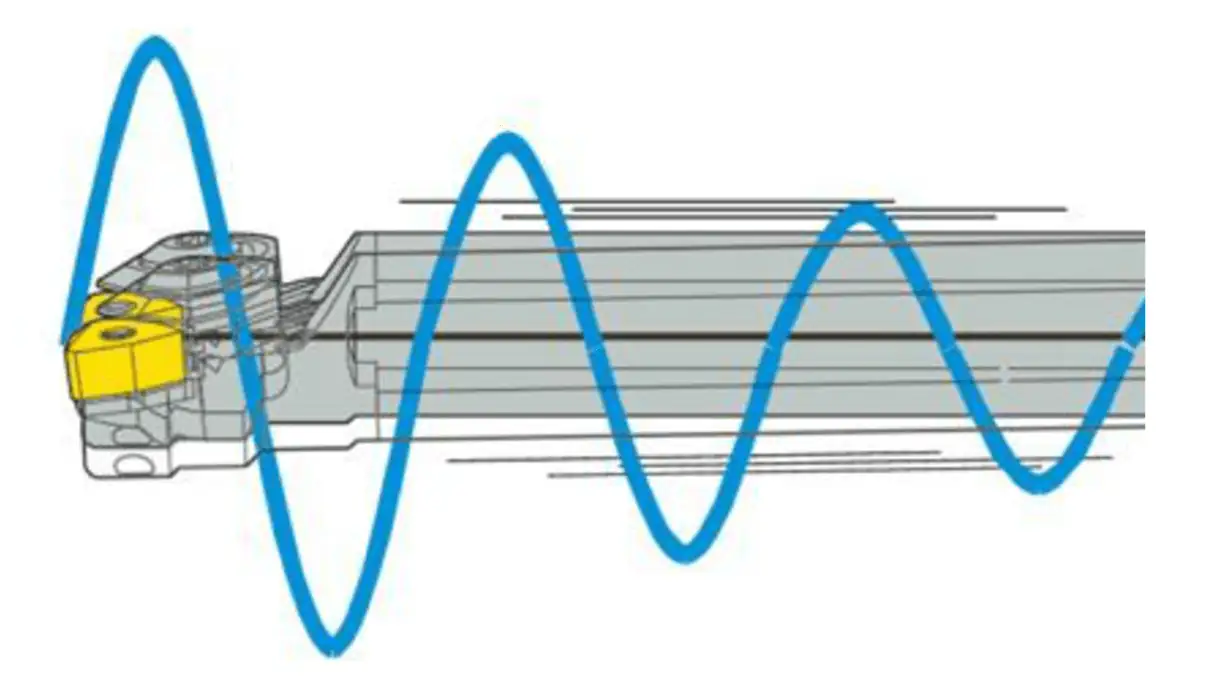
Every machinist knows the sound. It starts as a low hum, quickly escalates into a high-pitched squeal, and ends with a ruined surface finish, a chipped cutting tool, and a headache. In the world of manufacturing, this phenomenon is known as “chatter.” It is the arch-nemesis of precision, the thief of tool life, and the primary barrier between a good part and a great one.
While modern CNC machines are marvels of rigidity and speed, chatter remains a persistent challenge. It transcends the type of machine, the material being cut, or the experience level of the operator. Understanding chatter is not just about fixing a problem when it arises; it is about understanding the fundamental physics of the cutting process. This guide will dive deep into the mechanics of chatter, how to identify it, the science behind stability lobes, and practical strategies to silence the scream forever.
The Physics of the Problem: What Exactly is Chatter?
To solve chatter, we must first define it. In machining terms, chatter is a self-excited vibration that occurs during the cutting process. It is distinct from forced vibration. Forced vibration is caused by an external source, such as an unbalanced rotating component, a damaged bearing, or a motor running at a specific frequency. If you turn the machine off and the vibration stops, it was likely forced vibration.
Chatter, however, is self-sustaining. It is generated by the interaction between the cutting tool and the workpiece. Once it starts, it feeds on its own energy. The primary mechanism behind this is known as the Regenerative Effect.
The Regenerative Effect
Imagine a milling cutter rotating against a workpiece. Ideally, the tool removes a uniform layer of material. However, due to minor inconsistencies in the material or the machine structure, the tool might vibrate slightly during the first pass. This vibration leaves a wavy surface on the workpiece, often invisible to the naked eye but present on a microscopic level.
When the next tooth of the cutter comes around to take the next cut, it encounters this wavy surface. If the phase of the vibration aligns incorrectly, the tool bites into the “peak” of the wave left by the previous tooth. This causes a variation in chip thickness. A thicker chip requires more cutting force, which pushes the tool away further, creating a deeper wave. This deeper wave causes an even thicker chip on the subsequent revolution.
This feedback loop amplifies exponentially in milliseconds. The vibration grows until the energy dissipated by damping in the system equals the energy input from the cutting process. The result is the violent oscillation we hear and see as chatter.
Natural Frequency and Resonance
Every physical object has a natural frequency—a specific rate at which it wants to vibrate when struck. This applies to the spindle, the tool holder, the cutting tool, and the workpiece itself. When the frequency of the cutting force (determined by spindle speed and the number of flutes) approaches the natural frequency of the system, resonance occurs.
In a resonant state, even a tiny input of energy creates a massive output of vibration. Machining chatter is essentially the cutting process locking into the natural frequency of the machine-tool-workpiece system. Understanding that the machine structure is not infinitely rigid is the first step in combating this issue.
Types of Chatter in Machining
Chatter is not a monolith; it manifests in different ways depending on the machining operation and the direction of the forces involved.
1. Torsional Chatter
This occurs primarily in drilling or when using long end mills. The vibration happens around the axis of the tool’s rotation. The tool twists back and forth torsionally. This is often caused by a lack of torsional rigidity in the tool holder or the tool itself. It results in poor hole straightness and rapid wear on the cutting edges.
2. Axial Chatter
Axial chatter involves vibration along the length of the tool (up and down). This is common in deep pocket milling where the tool overhang is significant. The tool acts like a diving board, bouncing up and down as it engages the material. This leads to inconsistent depth of cut and poor surface finish on the floor of the pocket.
3. Radial Chatter
This is the most common form, involving vibration perpendicular to the tool axis (side-to-side). It creates the characteristic “chatter marks” on the side walls of a milled part. In turning operations, this manifests as the tool pushing away from the workpiece and then digging back in, creating a spiraled pattern on the diameter.
4. Workpiece Chatter
Often overlooked, chatter isn’t always the tool’s fault. If a workpiece is thin-walled or poorly supported, it can vibrate. In this scenario, the tool is rigid, but the part moves away from the cut. This is prevalent in aerospace manufacturing when machining thin aluminum skins or turbine blades. The solution here lies not in changing the tool, but in improving workholding or adding internal damping to the part.
Identifying Chatter: The Signs and Symptoms
Before you can fix chatter, you must recognize it. Experienced machinists can often detect the onset of chatter before it becomes catastrophic.
Auditory Signs
The sound of machining should be a consistent, smooth hum. Chatter introduces a dissonant frequency. It often sounds like a squeal, a screech, or a rhythmic banging. If the sound pitch changes suddenly as you engage the cut, you are likely entering an unstable zone. In CNC machining, listening to the spindle load meter can also help; chatter causes erratic spikes in load percentage even if the feed rate is constant.
Visual Signs
The surface finish is the ultimate tell-tale sign. Chatter marks appear as regular, periodic patterns on the machined surface.
- In Milling: Look for “frosting” or a textured pattern on the side walls. If the finish looks like it was sanded with coarse grit rather than cut, it is chatter.
- In Turning: Look for spiral marks around the diameter. If the lines are evenly spaced and vibrate the tool post, it is chatter.
- Chip Formation: Healthy chips should be consistent in shape and color. Chatter often produces segmented, irregular chips, or “dust” where continuous ribbons should be.
Tactile Signs
If you place your hand on the machine guard or the spindle housing (safely), you can feel chatter. Forced vibration feels like a steady buzz. Chatter feels like a violent, irregular shaking. In severe cases, you can see the tool or workpiece blurring due to the amplitude of the vibration.
The Stability Lobe Diagram: Mapping the Safe Zones
For decades, machinists relied on trial and error to avoid chatter. “If it chatters, slow it down,” was the common mantra. However, slowing down isn’t always the answer. In fact, sometimes speeding up is the solution. This concept is visualized through the Stability Lobe Diagram (SLD).
An SLD is a graph that plots Spindle Speed (RPM) on the X-axis and Depth of Cut (DOC) on the Y-axis. The graph is divided into stable and unstable zones.
Understanding the Lobes
The “lobes” on the diagram represent pockets of stability.
- Valleys: These are unstable zones where chatter is likely to occur at specific RPMs.
- Peaks: These are stable zones where you can take a much deeper cut without chatter.
Why does this happen? It comes back to the phase relationship between the tool teeth and the wavy surface left by the previous tooth. At certain speeds, the tool tooth lands in the “valley” of the previous wave, reducing chip thickness and damping the vibration. At other speeds, it lands on the “peak,” amplifying it.
Practical Application of SLDs
In the past, generating an SLD required complex mathematical modeling and impact testing (hitting the tool with a hammer and measuring the response). Today, modern CAM software and adaptive control systems can calculate these zones dynamically.
For the manual machinist or programmer without access to high-end software, the lesson is simple: RPM is a tuning knob. If you are experiencing chatter at 3,000 RPM with a 4-flute end mill, do not just reduce the depth of cut. Try increasing the RPM to 3,500 or decreasing it to 2,500. You might find that a higher speed allows for a more stable cut than a lower speed. This is why high-speed machining (HSM) strategies often utilize high RPM and moderate feed rates to stay within the stability lobes.
Practical Solutions and Mitigation Strategies
Understanding the theory is vital, but stopping the chatter on the shop floor is the priority. Here is a hierarchical approach to eliminating chatter, starting from the easiest adjustments to more complex interventions.
1. Optimize Cutting Parameters
The first line of defense is adjusting the cutting data.
- Spindle Speed: As mentioned, adjust the RPM by at least 5-10%. Moving away from the resonant frequency can break the feedback loop.
- Depth of Cut (DOC): Reducing the radial or axial DOC reduces the cutting force. Less force means less deflection, which reduces the amplitude of vibration. However, remember the stability lobes; sometimes a slightly deeper cut at a different speed is more stable than a shallow cut at a bad speed.
- Feed Rate: Increasing the feed per tooth can sometimes help. A thicker chip can act as a damper, absorbing some of the vibration energy. However, be careful not to exceed the tool’s load capacity.
- Stepover: In milling, reducing the radial stepover (the width of the cut) significantly lowers the radial force, which is the primary driver of tool deflection.
2. Tooling Selection and Geometry
The tool itself is a major variable in the system’s rigidity.
- Minimize Overhang: This is the golden rule. The force required to deflect a tool increases exponentially with length. A tool sticking out 4 times its diameter is significantly less rigid than one sticking out 3 times its diameter. Always use the shortest tool possible for the job.
- Tool Diameter: Use the largest diameter tool possible. A 1/2″ end mill is exponentially more rigid than a 3/8″ end mill.
- Variable Pitch/Variable Helix: Standard end mills have evenly spaced flutes. This means every tooth hits the workpiece at regular intervals, reinforcing the vibration frequency. Variable pitch end mills have uneven spacing between flutes. This disrupts the harmonic frequency, preventing the regenerative effect from locking in. They are highly effective for chatter suppression.
- Tool Material: Carbide is stiffer than High-Speed Steel (HSS). Switching to a solid carbide tool can increase rigidity and dampen vibration.
- Worn Tools: A dull tool requires more cutting force. More force equals more deflection. Always ensure tools are sharp. Paradoxically, a slightly worn tool might sometimes cut more smoothly than a brand new one due to edge honing, but generally, sharpness is key.
3. Workholding and Rigidity
If the part moves, it chatters.
- Support the Workpiece: In milling, ensure the part is clamped close to the area being cut. In turning, use a tailstock or steady rest for long, slender parts.
- Fill Hollow Parts: If machining a thin-walled tube, filling the inside with wax, sand, or a low-melting-point alloy can provide internal damping and support the walls from the inside out.
- Vises and Fixtures: Ensure the vise is clean and the parallels are seated. A part that is not sitting flat will vibrate under load.
4. Machine Maintenance
Sometimes the machine is the source of the looseness.
- Gibbs and Way Adjustment: On manual machines, loose gibs allow the axes to shift under load. Tighten them to remove slack but ensure the axes still move smoothly.
- Spindle Bearings: Worn spindle bearings introduce runout and vibration. If chatter persists across all tools and parameters, the spindle may need service.
- Tool Holder Maintenance: Dirty tapers or worn collets reduce grip and rigidity. Clean all tapers before insertion.
5. Advanced Damping Technologies
For difficult applications, specialized tooling exists.
- Damping Tool Holders: These holders contain internal mechanisms (often a mass-spring system or viscous fluid) that absorb vibration energy before it reaches the spindle. They are expensive but invaluable for deep-cavity machining.
- Active Damping: Some high-end spindles have sensors and actuators that detect vibration and apply a counter-force in real-time to cancel it out. This is the cutting edge of machining technology.
Chatter in Specific Materials
Different materials react differently to chatter, requiring tailored approaches.
Aluminum
Aluminum is generally forgiving, but its low damping capacity means vibrations can persist. High speeds are usually the answer. Using a high helix angle (40 degrees or more) helps lift chips quickly and reduces cutting forces.
Steel and Iron
These materials have higher damping capacity than aluminum but require more cutting force. Chatter here is often due to insufficient rigidity. Slower speeds with higher feed rates and robust tool holders (like hydraulic chucks) work best.
Titanium and Superalloys
These are the hardest to machine. They work-harden quickly and generate high heat. Chatter in titanium can ruin the surface integrity, leading to part failure in service. Conservative depths of cut, trochoidal milling paths (circular interpolation), and high-pressure coolant are essential to manage the heat and force.
The Human Element: Experience and Intuition
Despite all the technology, the machinist’s intuition remains invaluable. Software can calculate stability lobes, but it cannot feel the cut. An experienced operator listens to the change in pitch when the tool engages a corner. They feel the vibration through the floor.
Developing this intuition takes time. It involves experimenting with parameters and observing the results. Keep a log of successful cuts. If a specific tool and material combination worked well at 4,200 RPM with a 0.050″ DOC, record it. Over time, you build a personal database of stable zones for your specific machine environment. Remember, no two machines are identical; a program that runs perfectly on one CNC might chatter on an identical model next to it due to foundation differences or wear.
The Future of Chatter Control
The future of machining is smart and adaptive. We are moving away from static G-code programs toward dynamic processes.
IoT and Sensors: Modern spindles are being equipped with accelerometers and power sensors. These can detect the onset of chatter milliseconds before it becomes audible. The machine control can then automatically adjust the spindle speed or feed rate in real-time to move back into a stable zone.
AI and Machine Learning: CAM software is beginning to utilize AI to predict chatter. By analyzing the geometry of the part and the toolpath, the software can identify high-risk areas (like long overhangs or corner engagements) and automatically adjust the feed rate locally, slowing down only where necessary and speeding up where the cut is stable.
Digital Twins: Manufacturers are creating digital replicas of their machines and processes. Before a single chip is cut, the program is simulated on the digital twin, which predicts vibration and stability issues, allowing the programmer to fix the chatter virtually.
Conclusion
Chatter in machining is more than just an annoyance; it is a physical manifestation of the limits of rigidity and dynamics. It is a complex interplay of forces, frequencies, and materials. While it can never be entirely eliminated from the manufacturing world, it can be managed, mitigated, and often conquered.
By understanding the regenerative nature of chatter, utilizing stability lobe concepts, and adhering to principles of rigidity in tooling and workholding, machinists can push the boundaries of what their machines can do. The goal is not just to stop the noise, but to achieve a process that is robust, repeatable, and efficient.
Whether you are a hobbyist running a benchtop mill or a production engineer overseeing a cell of 5-axis machines, the principles remain the same. Respect the physics, listen to the machine, and never underestimate the power of a shorter tool overhang. Silencing the scream of chatter is the mark of a true craftsman, leading to parts that are not only dimensionally accurate but possess the surface integrity required for the demanding applications of the modern world. The next time you hear that high-pitched squeal, don’t just reach for the feed hold. Analyze the frequency, check your rigidity, and tune your process. Precision awaits in the silence.