
In the world of high precision manufacturing, the debate over the “best” CNC control is a constant topic of conversation on shop floors around the globe. While there are titans in the industry like Fanuc and Siemens, one name stands as the undisputed benchmark for quality, intuitiveness, and precision in the European market: HEIDENHAIN.
If you walk into a job shop specializing in mold making, aerospace components, or high end medical devices, the chances are high you will see the distinctive blue and white interface of a HEIDENHAIN control. Found on the premier machine tools of our time DMG Mori, Hermle, Mikron, and Spinner HEIDENHAIN controls have cultivated a near fanatical following among machinists.
But how did we get here? From the green screens of the 1980s to the touch enabled, high speed digital twins of today, the evolution of HEIDENHAIN controls mirrors the evolution of modern machining itself.
In this deep dive, we will explore the lineage of HEIDENHAIN milling controls, categorizing them by generation, examining their technical contributions, and understanding why they remain the control of choice for the world’s most demanding machining centers.
The Heidenhain Philosophy: Why It Matters
Before we dissect specific models, it is crucial to understand why HEIDENHAIN occupies such a unique position in the market. Unlike many competitors who rely heavily on standard G code (ISO programming) as their primary language, HEIDENHAIN built its reputation on Conversational Programming.
Known as “Klartext” (Clear Text) programming, this philosophy allows the operator to program complex geometry in plain language. Instead of memorizing cryptic G codes, the machinist interacts with a dialogue system that asks questions in plain English (or German/French, etc.): where is the circle center? What is the feed rate? What is the depth?
This approach democratized precision machining. It allowed skilled tradespeople, who might not have had a background in computer science, to program complex 3D paths and cycles right at the machine. This legacy of “Human Centric” design is the thread that connects every generation of their controls.
Part 1: The Legacy Generations (Still Running Strong)
One of the most remarkable testaments to HEIDENHAIN engineering is the longevity of their older controls. It is not uncommon to walk into a production facility today and see a machine from the early 1990s running a TNC 426, still holding tolerances within microns.
TNC 145 / TNC 150 / TNC 155: The Pioneers
Status: Vintage (Rare but functional)
Era: Early 1980s
These units represent the dawn of the digital workshop. The TNC 145, 150, and 155 were among the first controls to move away from punched tape and into electronic memory. While primitive by modern standards characterized by monochrome green screens and membrane keypads they introduced the concept of the “Tool Call” and the visual cycle.
These controls were designed for the rigid, manual knee mills and early vertical machining centers. They offered basic linear and circular interpolation. For many machinists currently in their 50s and 60s, the TNC 155 was likely their first interaction with a digital readout that could actually control the machine’s movement. They are essentially the “classic cars” of the CNC world: finicky to maintain, but historically significant for introducing the conversational concept.
TNC 355: The Bridge to Modernity
Status: Legacy
Era: Late 1980s to mid 1990s
If the 150 series was the pioneer, the TNC 355 was the workhorse that solidified Heidenhain’s reputation. This control arrived during a massive transition in manufacturing: the shift from manual operation to fully automated CNC.
The TNC 355 introduced more robust cycle functions. Suddenly, operators could program pocket milling and roughing cycles without writing thousands of lines of code. It offered better memory management and a more responsive processor, allowing for slightly faster feeds.
Visually, it was still very “retro,” often utilizing CRT monitors. However, the logic inside was sound. The TNC 355 proved that conversational programming could compete with G code for efficiency. These machines are rarely found in high production automotive environments today, but they still exist in maintenance shops and tool and die rooms where reliability trumps flashiness.
TNC 426 / TNC 430: The Ironclad Standards
Status: Intermediate / Still Widely Used
Era: Mid 1990s to early 2000s
This generation represents a sweet spot for used machine buyers. The TNC 426 and 430 are legendary for their reliability. These controls marked the transition to LCD screens (eventually) and introduced far superior 3D management compared to the 355.
The TNC 426 is particularly famous for its ruggedness. It is a “boots on the ground” control. It doesn’t have the flashy 3D simulation of modern controls, but it runs code fast and accurately. The 430 added further capabilities, handling more complex geometries and offering better connectivity options for CAD/CAM transfer via RS 232.
Even today, purchasing a used DMG or Deckel Maho machine equipped with a TNC 426 is considered a safe investment for a startup shop. The parts are available, the technology is stable, and the programming logic is exactly the same as the modern controls, meaning staff can switch between a 1995 machine and a 2024 machine with zero retraining time.
Part 2: The Modern Era (The Industry Standards)
Here we enter the territory of the controls that defined the 21st century machine shop. These units possess the processing power to handle complex surfacing, high speed machining, and multi axis interpolation.
iTNC 530: The Legend
Status: Industry Standard / Workhorse
Popularity: ⭐⭐⭐⭐⭐
If you ask a seasoned machinist to name the Heidenhain control, they will likely say the iTNC 530. This unit is arguably one of the most successful CNC controls ever produced.
Released in the early 2000s, the iTNC 530 was a technological leap. The “i” stood for “interactive” and “internet,” signaling the arrival of networked manufacturing. It featured a color TFT screen, a Windows based operating system running in the background for file management, and a massive leap in processing speed.
Key Features:
- 5 Axis Simultaneous Machining: The iTNC 530 made 5 axis machining accessible. It handled kinematics transformations natively, allowing shops to machine complex impellers and turbine blades without needing an external CAM system for every operation.
- Dynamic Collision Prevention (DCP): This was a game changer. The control could “see” potential crashes between the tool holder and the machine structure (or clamps) and stop the machine milliseconds before impact.
- Mold Making Favorite: In the mold and die industry, the iTNC 530 became the gold standard. Its ability to handle millions of points in a spline interpolation without stuttering was unmatched.
Even though it has been succeeded by the 640 and TNC7, the iTNC 530 remains the most common control found on the second hand market for premium European machines. It is the “AK 47” of CNC controls: reliable, ubiquitous, and powerful.
TNC 620: The Compact Powerhouse
Status: Modern
Popularity: ⭐⭐⭐
The TNC 620 was released as a successor to the TNC 426/430 and a compact alternative to the 530. It was designed specifically for 3 axis milling and simple 5 axis machines (often 3+2 axis positioning).
The interface was modernized significantly. The graphics engine was overhauled to provide sharper simulation views. For many general mechanics shops that don’t need the extreme complexity of aerospace machining, the TNC 620 is perfect. It is cost effective, fast, and retains the classic Heidenhain programming style.
It serves as a bridge between the heavy duty iTNC 530 and the ultra-modern TNC 640, offering a modern user experience without the overhead of high end 5 axis simultaneous functionalities that simpler shops might not utilize.
TNC 640: The High Performance Benchmark
Status: High End / Current Flagship
Popularity: ⭐⭐⭐⭐
The TNC 640 is the machine you find on a brand new Hermle C42 or a DMG Mori DMU series. It represents the current state of the art for production machining.
High Speed Machining (HSM): The TNC 640 is built for speed. It utilizes “Dynamic Efficiency” functions that automatically adjust the feed rate in corners to maintain tool load and prevent chatter. This allows machinists to push tools faster and deeper than ever before.
Multitasking: Modern shops are moving toward “Done in One” machining. The TNC 640 supports turning operations on a milling machine (Turn Mill). If you have a 5 axis machine with a trunnion, you can now flip the part and turn it like a lathe using the milling spindle. The TNC 640 handles the coordinate transformations for this effortlessly.
User Experience: The visual simulation on the TNC 640 is almost photorealistic. It renders the entire machine envelope, the workpiece, the clamps, and the toolpath in real time. This reduces the “fear factor” for operators running expensive parts. If you can see the crash on the screen, you won’t crash it on the machine.
Part 3: The New Generation (The Future)
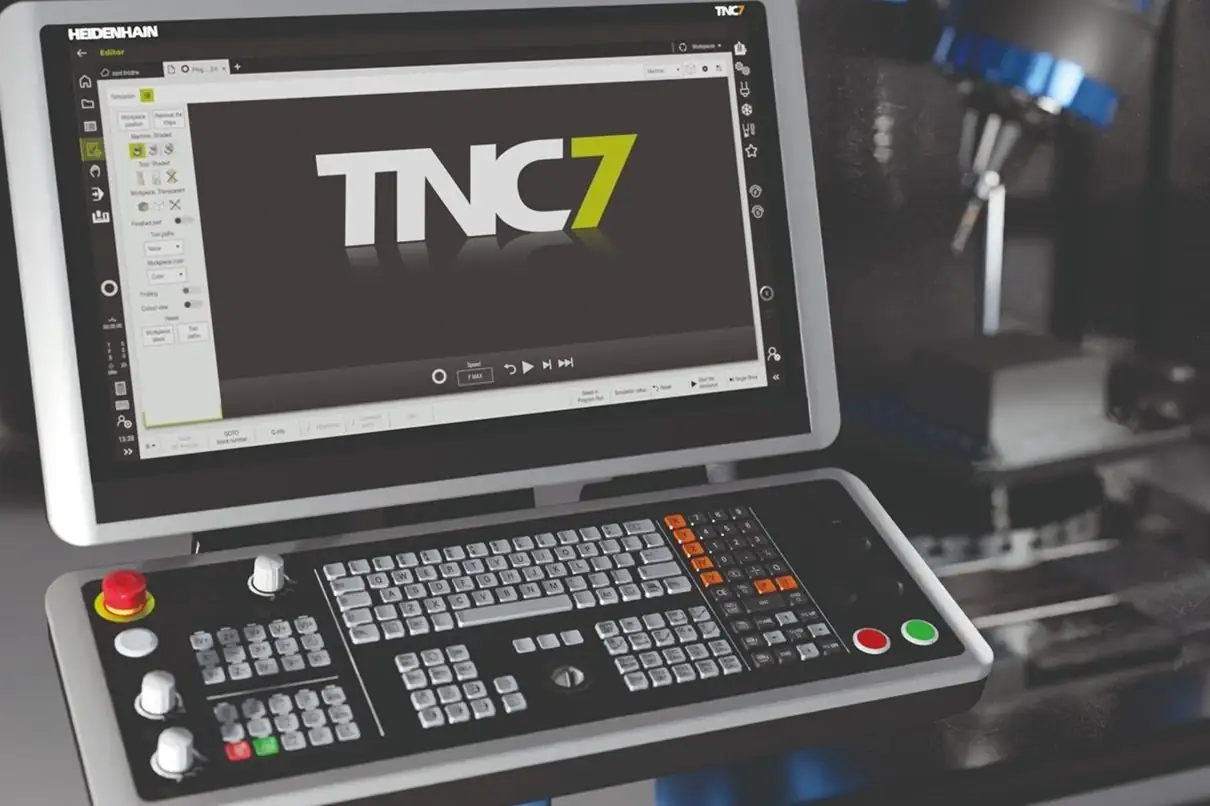
TNC7: The Digital Native
Status: Next Generation
Popularity: Growing (Standard on new premium machines)
The TNC7 is a radical departure from the past 30 years of Heidenhain design. While it retains the conversational “Klartext” logic at its core, the hardware and interface have been completely reinvented for the digital age.
Touch and Gesture Control: For the first time, Heidenhain has fully embraced touch. The TNC7 functions like a tablet. You can pinch to zoom on the workpiece, swipe through program lines, and tap icons to select cycles. This appeals to a younger generation of machinists who are used to smartphones.
Intuitive Programming: The TNC7 introduces a “Programming Station” that is almost like having a simplified CAD system built into the control. You can define contours graphically, and the control writes the code for you.
Optimized for Digitalization: The TNC7 is built for Industry 4.0. It connects seamlessly to factory networks, supports remote diagnostics, and can utilize digital twins for perfect offline simulation. As machine tools become more integrated with automation and robotics, the TNC7 acts as the central brain, managing not just the spindle, but the entire manufacturing cell.
Summary Table: Quick Reference Guide
To help you identify the control you see on a shop floor or are considering for purchase, here is a quick summary of the hierarchy:
| Control Model | Generation | Level | Current Popularity |
| TNC 145 / 155 | Vintage | Old | ⭐ (Museum/Maintenance) |
| TNC 355 | Legacy | Old | ⭐⭐ (Tool rooms) |
| TNC 426 / 430 | Intermediate | Mid range | ⭐⭐⭐ (Used market king) |
| iTNC 530 | Modern | Industry Standard | ⭐⭐⭐⭐⭐ (Universal) |
| TNC 620 | Modern | Compact/3 Axis | ⭐⭐⭐ |
| TNC 640 | Modern | High End / 5 Axis | ⭐⭐⭐⭐ (Premium choice) |
| TNC7 | Future | Next Gen | ⭐⭐⭐ (Rapidly growing) |
Why HEIDENHAIN Reigns Supreme: The “Secret Sauce”
The list of controls above tells a story of hardware evolution, but the reason for Heidenhain’s dominance lies in three core pillars of software and mechanical engineering.
1. Conversational Programming (Klartext)
On a Fanuc control, if you want to mill a pocket, you might need to write lines of G code defining the G17 plane, the G41 compensation, the approach moves, the cut depths, and the retract moves.
On a Heidenhain (any model from the TNC 355 to the TNC7), you press the “Pocket Milling” button. A window pops up. You type:
Width: 50
Length: 100
Depth: 20
Corner Radius: 5
Feed Rate: 2000
You press “OK,” and the machine generates a perfectly optimized cycle. This speed of programming “at the control” is why job shops prefer Heidenhain. If a programmer needs to change a dimension on a pocket, they just edit the number in the cycle. They don’t have to rewrite the G code logic.
2. Mastery of 5 Axis Machining
Heidenhain controls were among the first to make 5 axis machining manageable for the average shop. Features like “Plane Spatial” allow the operator to tilt the tool into any angle, and the control automatically rotates the coordinate system to match the tilted plane.
On the iTNC 530 and TNC 640, the TCP (Tool Center Point) management is flawless. When the machine rotates the rotary axes (A and C, for example), the control automatically compensates for the tool length and radius so the tool tip stays exactly where it should be. This means the programmer doesn’t have to calculate complex trigonometry; the control does it in real time.
3. Precision in 3D Interpolation
Heidenhain is primarily a measurement technology company. They make the linear encoders (glass scales) that sit inside the machine axes. Because they manufacture both the control and the measuring systems, the integration is seamless.
This is particularly evident in 3D interpolation. When machining a complex mold surface composed of thousands of tiny line segments, the control must process points faster than the machine can move. Heidenhain controls utilize sophisticated look ahead algorithms (often looking 500 to 2000 lines ahead) to slow down for corners and accelerate on straights. The result is a surface finish that requires less hand polishing a massive cost saving in mold making.
The Used Machine Market: What to Buy?
For entrepreneurs or shop managers looking to expand capacity on a budget, the Heidenhain lineage provides a clear roadmap.
If you find a machine with a TNC 426 or 430, buy with confidence if the mechanicals are sound. The control is robust, and parts support is still available. It is the safest bet for a used VMC (Vertical Machining Center).
If you find a machine with an iTNC 530, you are looking at a machine that is likely 10 15 years old but performs like a modern 5 axis workhorse. These are highly sought after. If the price is right, it is an excellent investment.
Be cautious with TNC 355 and older models. These are best left to hobbyists or shops with in house electrical maintenance capabilities. The hardware is obsolete, and finding replacement boards can be difficult.
Conclusion: The Future is Clear
Heidenhain has achieved something rare in the industrial world: they have evolved their technology drastically while keeping their user base intact. A machinist who learned on a TNC 155 in 1985 can walk up to a TNC7 in 2024 and, within minutes, recognize the cycle parameters and the logic of the code.
As manufacturing moves toward the TNC7 and full digital integration, the core values remain the same. Whether it is an old TNC 426 humming in the corner of a job shop or a sleek TNC 640 carving aerospace alloys at 20,000 RPM, Heidenhain continues to define what it means to machine with precision. For the European machine tool industry, and indeed for high end manufacturers worldwide, the blue interface is not just a control it is a badge of quality.