
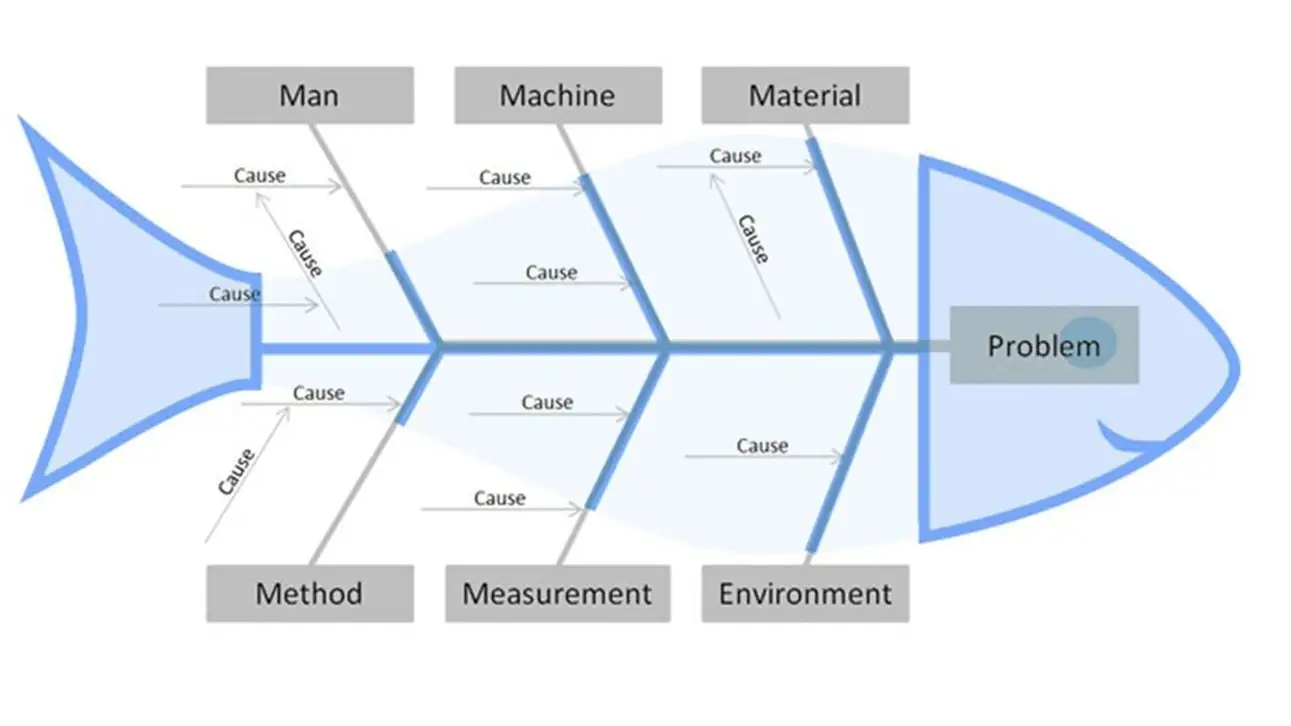
In the complex landscape of business management, engineering, and quality control, problems are inevitable. Whether it is a manufacturing defect, a software deployment failure, or a dip in customer satisfaction, the immediate reaction is often to fix the symptom. However, treating symptoms without addressing the underlying disease guarantees that the problem will return. This is where the Ishikawa Diagram becomes an indispensable tool.
Often referred to as the Fishbone Diagram or the Cause-and-Effect Diagram, this visual framework is one of the seven basic tools of quality control. It provides a structured way to explore all potential causes of a specific problem, guiding teams away from blame and toward systemic understanding.
In this comprehensive guide, we will delve deep into the history, anatomy, application, and strategic value of the Ishikawa Diagram. By the end of this post, you will understand not just how to draw one, but how to leverage it to transform your organization’s problem-solving culture.
The Origins: Who Was Kaoru Ishikawa?
To understand the tool, one must understand the man behind it. Kaoru Ishikawa was a Japanese organizational theorist and a key figure in the quality management movement. Born in 1915, Ishikawa was instrumental in Japan’s post-World War II economic rebirth. While American experts like W. Edwards Deming and Joseph Juran introduced statistical quality control methods to Japan, it was Ishikawa who adapted these concepts to fit the Japanese cultural and industrial context.
In the 1960s, while working at the University of Tokyo and consulting for companies like Kawasaki Heavy Industries, Ishikawa realized that quality control was not just the responsibility of engineers or management. He believed that quality was everyone’s job. This philosophy led to the creation of Quality Circles, small groups of workers who voluntarily met to discuss workplace improvements.
The Ishikawa Diagram was developed around 1968 as a way to facilitate these discussions. Ishikawa needed a method that was visual, simple enough for frontline workers to understand, yet robust enough to handle complex engineering challenges. He wanted to move organizations away from “fire-fighting” (reacting to problems) to “fire-prevention” (identifying root causes). His work democratized quality control, making it accessible to the entire workforce rather than siloing it within a specialized department.
Anatomy of the Fishbone
The visual metaphor of the Ishikawa Diagram is its greatest strength. It resembles the skeleton of a fish, which makes it easy to remember and intuitive to read.
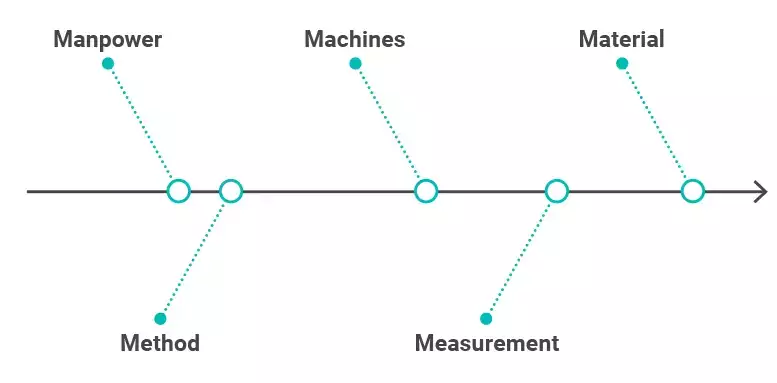
- The Head: On the right side of the diagram, a box is drawn containing the “Effect” or the problem statement. This is the issue you are trying to solve (e.g., “High Defect Rate” or “Delayed Shipping”).
- The Spine: A horizontal arrow points directly to the head. This represents the backbone of the analysis, connecting the causes to the effect.
- The Ribs (Primary Causes): Diagonal lines branch off the spine. These represent the major categories of potential causes.
- The Sub-Ribs (Secondary Causes): Smaller lines branch off the primary ribs. These represent more specific causes within the categories.
- The Bones (Root Causes): Further branching can occur to drill down into the deepest level of causality.
This structure forces the team to categorize their thoughts. Instead of a chaotic list of complaints, the diagram organizes potential variables into logical streams, making the complex manageable.
The Categories: The 6 Ms and Beyond
One of the most critical decisions when creating an Ishikawa Diagram is selecting the categories for the “ribs.” While you can customize these based on your industry, there are standard frameworks that provide a solid starting point.
The 6 Ms (Manufacturing and Production)
This is the classic model used in manufacturing environments.
- Man (People): Is the issue related to human error, lack of training, fatigue, or communication?
- Machine (Equipment): Are tools, computers, or machinery malfunctioning or poorly maintained?
- Material (Raw Inputs): Are the raw materials defective, inconsistent, or of the wrong specification?
- Method (Process): Are the standard operating procedures (SOPs) unclear, outdated, or being bypassed?
- Measurement (Inspection): Is the data accurate? Are calibration errors leading to false readings?
- Mother Nature (Environment): Do temperature, humidity, lighting, or workspace layout affect the outcome?
The 5 Ps (Service Industry)
For service-oriented businesses, the 6 Ms often feel too mechanical. The 5 Ps are more appropriate:
- People: Staff competence and behavior.
- Process: The workflow and service delivery steps.
- Platform: The technology or infrastructure supporting the service.
- Policies: Rules and regulations that govern the service.
- Price: Financial constraints or budget issues affecting quality.
The 4 Ss (Retail and Administration)
- Surroundings: The physical environment.
- Suppliers: External vendors and partners.
- Systems: IT and administrative frameworks.
- Skills: Employee capabilities.
Selecting the right framework ensures that the team casts a wide net. If you are in software development, you might use categories like “Code,” “Infrastructure,” “Requirements,” and “Testing.” The goal is to ensure no stone is left unturned.
Step-by-Step Guide to Creating an Ishikawa Diagram
Creating a Fishbone Diagram is not a solitary activity; it is a workshop exercise. Here is a detailed workflow to conduct an effective session.
Step 1: Define the Problem Statement
The session begins with a clear, concise problem statement. This goes in the “head” of the fish. Vague problems lead to vague solutions.
- Bad: “Sales are down.”
- Good: “Q3 Sales in the Northeast Region decreased by 15% compared to Q2.”
Specificity helps the team focus on the actual effect rather than general grievances.
Step 2: Assemble the Right Team
You need a cross-functional group. If you are analyzing a production error, include machine operators, quality inspectors, supply chain managers, and maintenance staff. Diversity of perspective is crucial because a manager might see a “Method” issue, while an operator sees a “Machine” issue.
Step 3: Draw the Framework
Whether using a whiteboard, a large sheet of paper, or digital software, draw the spine and the head. Add the major category ribs (e.g., the 6 Ms). Having the structure ready before brainstorming begins prevents the conversation from drifting.
Step 4: Brainstorm Potential Causes
This is the divergent thinking phase. Ask the team: “Why is this happening?” Encourage volume over quality at this stage. Write every suggestion on a sticky note or directly on the corresponding rib.
- Rule: No criticism allowed. If someone suggests a cause that seems unlikely, write it down anyway. Evaluation comes later.
- Technique: Go around the room to ensure quiet team members contribute, not just the loudest voices.
Step 5: Categorize and Organize
As ideas emerge, place them under the appropriate category rib. If a cause fits multiple categories, duplicate it. Once the brainstorming slows down, review the diagram. Are there categories with very few causes? Prompt the team to think harder about those areas. “We have ten ideas for Machine, but only one for Man. Are we sure people aren’t a factor?”
Step 6: Drill Down with the “5 Whys”
This is where the diagram gains power. Take a primary cause (e.g., “Machine Overheating”) and ask “Why?” five times to find the root.
- Why did it overheat? Coolant level was low.
- Why was coolant low? There was a leak.
- Why was there a leak? The seal was worn.
- Why was the seal worn? It wasn’t replaced during maintenance.
- Why wasn’t it replaced? The maintenance schedule doesn’t include seal checks.
Root Cause: Inadequate maintenance schedule.
Add these deeper layers as sub-ribs on the diagram.
Step 7: Identify and Verify Root Causes
Review the completed diagram. Look for causes that appear repeatedly across different categories. Circle the top three to five most likely root causes. These are your hypotheses. You must now verify them with data. Do not assume the diagram is the truth; it is a map of potential truths. Use data analysis to confirm which cause is actually driving the problem.
Benefits of the Ishikawa Diagram
Why should you choose this tool over a simple list or a flowchart? The benefits are multifaceted.
1. Visual Clarity
Human brains process visual information faster than text. The Fishbone Diagram allows a team to see the relationship between various causes and the effect at a glance. It turns abstract concepts into a concrete map.
2. Promotes Collaboration
Because the diagram is built collectively, it fosters buy-in. When team members see their input on the board, they feel ownership of the solution. It breaks down silos by forcing different departments to look at the same problem together.
3. Prevents Premature Conclusions
In many meetings, the highest-paid person’s opinion (HiPPO) dictates the solution. The Ishikawa process forces the group to consider all categories before settling on a solution. It slows down the rush to judgment.
4. Educational Tool
For new employees, reviewing past Ishikawa Diagrams is an excellent way to learn about the system’s vulnerabilities. It documents institutional knowledge about what can go wrong and why.
5. Holistic View
It prevents “tunnel vision.” Without the categories, a team might focus entirely on technology. The 6 Ms force the team to consider environment, people, and processes, ensuring a systemic approach.
Limitations and Common Pitfalls
No tool is perfect. To use the Ishikawa Diagram effectively, you must be aware of its limitations.
1. Complexity in Large Systems
For extremely complex problems, the diagram can become unwieldy. If there are too many branches, the chart becomes a “hairball” that is impossible to read. In such cases, break the problem down into smaller sub-problems and create multiple diagrams.
2. Correlation vs. Causation
The diagram identifies potential causes, not proven ones. A common mistake is treating the brainstormed items as facts. Teams must remember that the diagram is a hypothesis generator, not a proof generator. Data validation is required after the session.
3. Subjectivity
The quality of the diagram depends on the knowledge of the participants. If the team lacks experience or expertise, they may miss critical causes. Ensure subject matter experts are present.
4. Time-Consuming
A proper session can take hours. In a crisis requiring immediate containment, a Fishbone analysis might be too slow. Use it for recurring or high-impact problems, not for every minor glitch.
5. Blame Culture
If not facilitated correctly, the “Man” category can devolve into blaming specific individuals. The facilitator must emphasize that the diagram analyzes roles and processes, not personal competence. Focus on “Why did the process allow this error?” rather than “Who made this error?”
Real-World Applications Across Industries
The versatility of the Ishikawa Diagram allows it to be applied far beyond its manufacturing origins.
Healthcare
In a hospital, patient safety is paramount. If there is a spike in post-surgical infections, a Fishbone Diagram can be used.
- Method: Sterilization protocols.
- Man: Hand hygiene compliance.
- Material: Quality of sutures or antibiotics.
- Environment: Air filtration in the operating theater.
By analyzing these factors, the hospital can pinpoint whether the issue is procedural or environmental.
Software Development
When a critical bug reaches production, a “Post-Mortem” often uses a Fishbone structure.
- Code: Logic errors or technical debt.
- Testing: Insufficient coverage or automated test failures.
- Requirements: Ambiguous user stories.
- Deployment: CI/CD pipeline configuration.
This helps engineering teams move beyond “the developer made a mistake” to “our code review process failed to catch this class of error.”
Human Resources
High employee turnover is a common HR challenge.
- Policy: Inflexible remote work rules.
- Price: Non-competitive salary bands.
- People: Management style of specific supervisors.
- Process: Onerous onboarding experiences.
This allows HR to address systemic retention issues rather than just hiring more people to replace those who leave.
Supply Chain
If shipments are consistently late:
- Suppliers: Vendor reliability.
- Systems: Inventory tracking software accuracy.
- Surroundings: Port congestion or weather.
- Skills: Logistics team training.
Integrating with Other Quality Tools
The Ishikawa Diagram shines brightest when used in conjunction with other quality management tools.
The Pareto Chart (80/20 Rule)
Once you have identified potential causes on the Fishbone, you can use a Pareto Chart to prioritize them. The Pareto principle suggests that 80% of problems come from 20% of causes. By collecting data on the frequency of the causes listed in your Ishikawa Diagram, you can plot a Pareto Chart to determine which “rib” of the fish is contributing the most to the problem. This tells you where to focus your resources.
The 5 Whys
As mentioned earlier, the 5 Whys is the engine that drives the depth of the Fishbone. While the Fishbone provides the breadth (covering all categories), the 5 Whys provides the depth (drilling down to the root). Using them together ensures you are both comprehensive and deep.
Failure Mode and Effects Analysis (FMEA)
FMEA is a proactive tool used to identify potential failures before they happen. You can use an Ishikawa Diagram reactively after a failure occurs. The insights gained from the reactive Fishbone analysis can be fed into the proactive FMEA to update risk scores and prevent future occurrences.
Digital vs. Analog: Choosing Your Medium
In the past, Ishikawa Diagrams were exclusively whiteboard exercises. Today, digital tools offer new possibilities.
Whiteboard/Post-Its (Analog)
- Pros: High engagement, tactile, no learning curve, encourages movement.
- Cons: Hard to save, hard to edit later, limited space, requires physical presence.
- Best For: Initial workshops, team building, quick sessions.
Digital Software (Miro, Lucidchart, Visio)
- Pros: Easy to save and share, editable over time, can link to data sources, supports remote teams.
- Cons: Can reduce engagement if people are just typing, learning curve, cost.
- Best For: Remote teams, documentation, long-term tracking of root cause resolution.
For the best results, consider a hybrid approach. Start the session on a whiteboard to maximize energy and collaboration. Once the diagram is finalized, transcribe it into a digital tool for record-keeping and action tracking.
Conclusion: Building a Culture of Inquiry
The Ishikawa Diagram is more than just a chart; it is a mindset. It represents a commitment to curiosity over assumption and system-improvement over blame. In a world where problems are becoming increasingly interconnected, the ability to disentangle cause and effect is a superpower.
By adopting the Fishbone Diagram, organizations can stop fighting the same fires repeatedly. They can move from a reactive stance to a proactive one, building resilience into their processes. Whether you are managing a factory floor, a software sprint, or a hospital ward, the principles remain the same: define the problem, gather the team, categorize the causes, and drill down to the root.
Kaoru Ishikawa’s legacy is not just the diagram that bears his name, but the philosophy that quality is a journey, not a destination. Every time you draw a fishbone, you are participating in that journey. You are declaring that the problem in front of you is solvable, provided you are willing to look deep enough.
So, the next time your team faces a stubborn challenge, resist the urge to jump to solutions. Grab a marker, draw a fish, and ask the most important question in business: “Why?” The answer might just transform your operation.
Action Plan for Your Next Session
To put this knowledge into practice immediately, consider the following checklist for your next problem-solving meeting:
- Select a specific problem (avoid vague topics).
- Invite 5-8 diverse participants.
- Choose your categories (6 Ms, 5 Ps, etc.).
- Schedule 60-90 minutes of uninterrupted time.
- Assign a facilitator to keep the discussion on track.
- Commit to data validation after the brainstorming session.
The Ishikawa Diagram is a timeless tool in the modern toolkit. Master it, and you master the art of root cause analysis.