

If you’ve spent time on a manual engine lathe, you already know the satisfaction of turning a raw chunk of metal into a precision part. But stepping onto a modern shop floor means you are going to encounter CNC lathes (Computer Numerical Control). While they might look intimidating with their enclosed guards and glowing control panels, they operate on the exact same fundamental physics as the manual machines you’re used to just with a computer doing the heavy lifting.
Let’s break down how CNC lathes work and what you need to know for your first time operating one.

What exactly is a CNC Lathe?
CNC stands for Computer Numerical Control. Instead of you turning hand wheels and pulling levers to move the cutting tool, a computer reads a set of programmed instructions and drives servo motors to move the tool and spindle with microscopic precision. Think of it as an autopilot for your cutting tools..
The Anatomy of a CNC Lathe
While the cutting principles are the same as a manual lathe, the layout is optimized for automation:
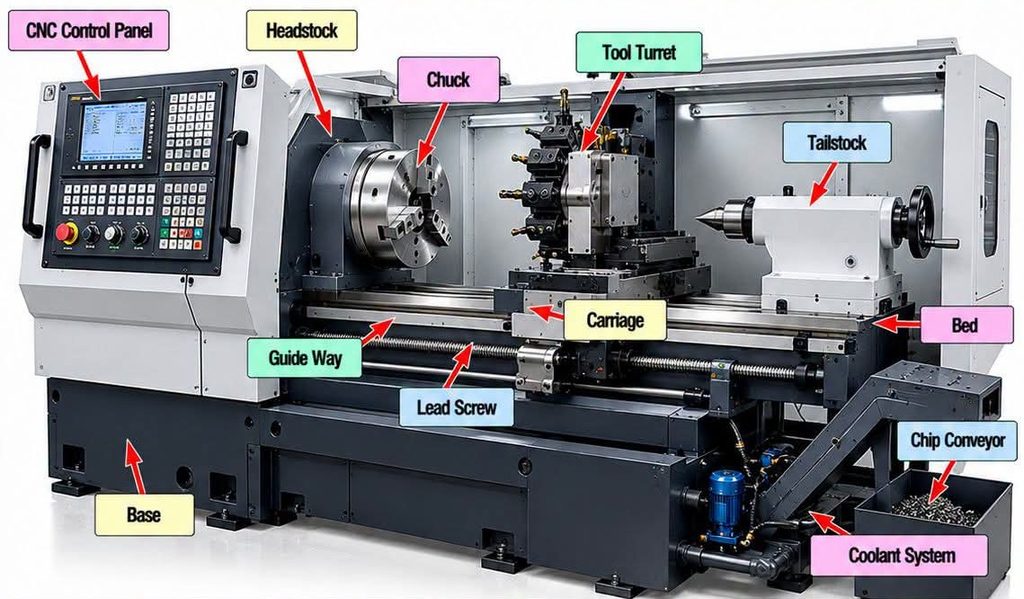
- The Chuck: Holds your raw stock (workpiece). Most CNC lathes use 3-jaw hydraulic or pneumatic power chucks for quick, consistent clamping pressure.
- The Turret: Instead of a single quick-change tool post, CNC lathes use a turret that holds multiple tools (turning, grooving, threading, boring bars) at once. The machine indexes to the correct tool automatically.
- The Spindle & Headstock: Spins the workpiece. CNC spindles can rapidly change RPMs on the fly to maintain Constant Surface Speed (CSS) as the tool cuts closer to the center of the part.
- The Tailstock / Sub-Spindle: Just like your manual lathe, it supports long parts or holds drills and reamers for ID (inside diameter) work. Many modern lathes feature a sub-spindle that grabs the part to machine the back side in a single setup.
How the Machining Process Works

Here’s a simplified explanation:
- The Setup: This is where you spend most of your time as a beginner. You’ll load the raw material into the chuck, load the required tools into the turret, and set your work offsets and tool offsets so the machine knows exactly where the part and tools are in 3D space.
- The Program: The part geometry is turned into code. The most common language is G-code (e.g., G00 for rapid move, G01 for linear feed), though many modern machines also feature conversational controls that allow you to program directly at the screen.
- The Cycle: The spindle spins, coolant floods the cut, and the turret feeds the tool along the programmed toolpath. You will perform operations like facing, OD (outside diameter) turning, ID boring, grooving, and threading.
- Quality Control: Once the cycle stops, you pull the part, measure it with micrometers and calipers, and adjust your tool wear offsets to ensure you hold tight tolerances.
Why Shops Run CNC Lathes
- Repeatability: Once dialed in, a CNC lathe will make the ten-thousandth part look exactly like the first one.
- Tight Tolerances: You can easily hold tolerances within a tenth (0.0001″) or less.
- Complex Geometries: CNC allows for complex contouring and precise threading profiles that would be a nightmare to calculate and cut manually.
- Efficiency: Machines can run unattended (often called “lights-out manufacturing”) and cycle times are incredibly fast compared to manual turning.

What Kinds of Things Are Made with a CNC Lathe?
CNC lathes are used to make all kinds of cylindrical or round parts, including:
- Screws and bolts
- Gears and shafts
- Medical devices like implants
- Automotive components like brake rotors
- Kitchenware like stainless steel bowls
Is It Magic?
Not quite! But it does feel like magic when you see a raw chunk of metal transformed into something beautiful and functional. The key is the combination of advanced software, skilled programmers, and reliable machinery working together seamlessly.
What It Takes to Operate a CNC Lathe?
Operating a CNC lathe ( CNC machine operator ) requires training because it involves understanding both the machine and the programming language (called G-code). However, modern machines come with user-friendly interfaces that make learning easier than ever before.
There’s an old shop joke that CNC stands for “Cannot See the Chips,” but operating a CNC lathe is a highly skilled trade. To be a good CNC operator or setup machinist, you need to understand:
- Feeds and Speeds: Knowing the right Surface Feet per Minute (SFM) and Inches per Revolution (IPR) for different materials (aluminum, stainless steel, titanium, plastics).
- G-Code and M-Code: The language of the machine (e.g., M03 starts the spindle, M08 turns on coolant, M30 ends the program).
- Tool Wear Compensation: Knowing how to tweak offsets to account for insert wear over a long production run without scrapping parts.
Tips for Your First Week on a CNC Lathe
1. Respect the “Feed Hold”: Always keep your hand near the Feed Hold button when you are proving out a new program or running a first article. If something sounds wrong, looks wrong, or the chips are packing up, hit it. It’s better to pause the cycle than crash the machine.
2. Check you’re Offsets: A simple typo in a Z-axis work offset will result in the turret ramming into the chuck or cutting air. Double, and then triple-check your setups.
3. Watch Your Chips: Good chips tell a story. Stringy, blue chips in steel usually mean your speed/feed is dialed in. Long, bird-nesting chips mean you need to adjust your feed rate, change your depth of cut, or use an insert with a better chip breaker.
4. Keep it Clean: Blow out the chuck, clean the tool holders before loading them into the turret, and keep the way covers clear of stringy chips. A clean machine is a happy, accurate machine.
Final Thoughts
Transitioning to a CNC lathe might feel overwhelming at first, but the foundational skills you learned on manual machines understanding cutting tool geometry, material properties, and basic machining physics will make you a top-tier CNC machinist. Take it one setup at a time, ask questions, and before long, you’ll be programming and setting up complex parts all on your own!


