
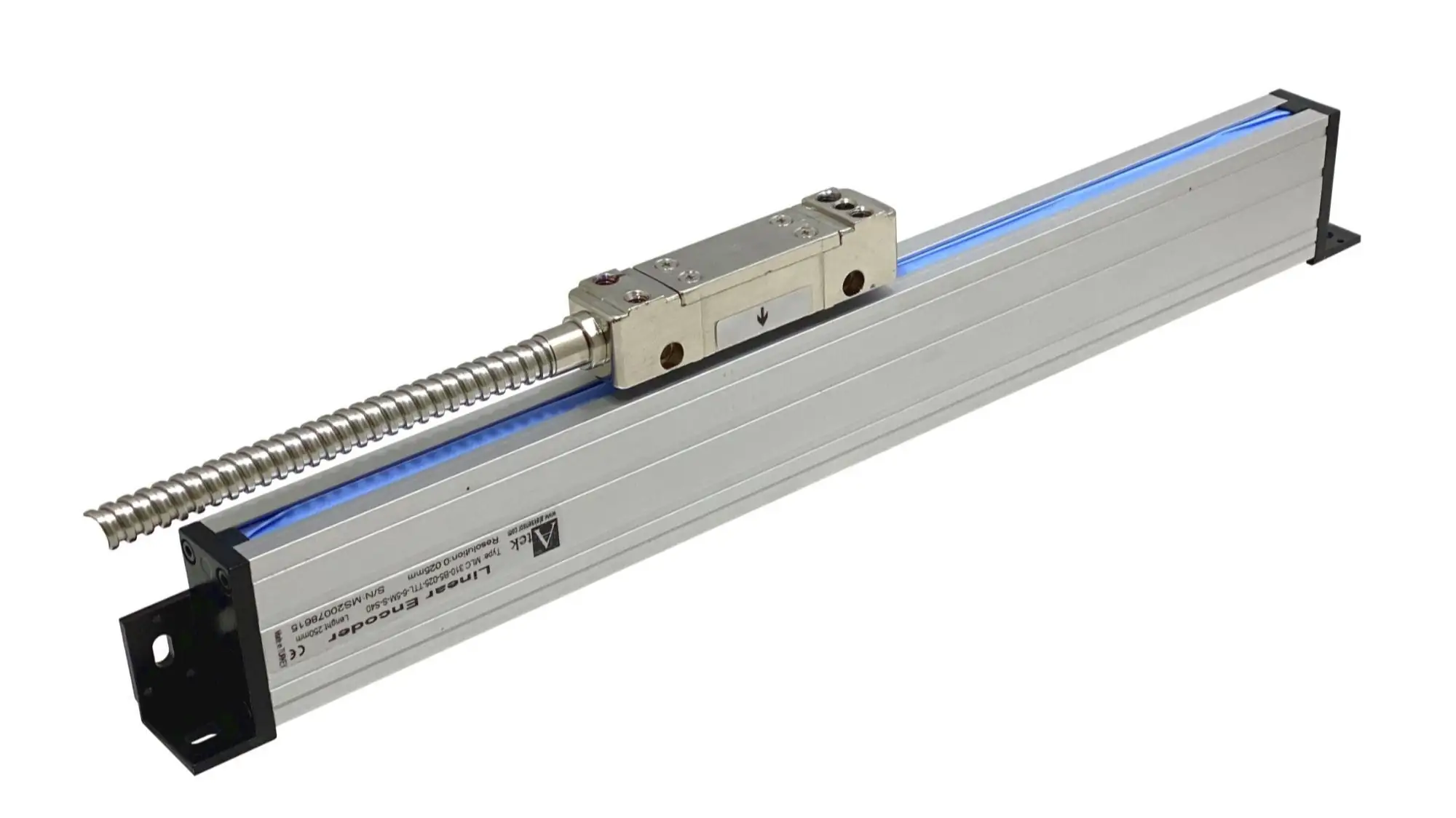
When it comes to achieving sub-micron precision in CNC machining, the difference between a perfect part and a rejected one often hinges not on the spindle, the tool, or even the coolant but on the humble, unassuming glass scale.
A glass scale (also called a linear glass encoder or linear position encoder) is a direct-measurement feedback device mounted along the machine’s axis of motion. Unlike rotary encoders that infer position from motor rotation, glass scales measure the actual position of the table or slide with nanometer-level accuracy bypassing ball screw errors, backlash, thermal expansion, and mechanical compliance entirely.
But not all glass scales are created equal. In 2025, the market is dominated by a handful of elite manufacturers, each offering distinct advantages in resolution, durability, integration, and critically price. Choosing the right one isn’t just about specs; it’s about matching technology to your production goals, budget, and environment.
What Exactly Is a Glass Scale?
A glass scale consists of a thin, ultra-flat glass strip etched with a periodic pattern of fine lines typically 1 to 100 micrometers apart. A read head, mounted on the moving axis, scans these lines optically using a light source and photodetectors. As the axis moves, interference patterns generated by the moving grating are converted into high-resolution digital position signals.
The result? Direct, real-time feedback of the tool’s actual position—with resolutions down to 0.1 nanometers and accuracies as tight as ±1 µm over 1 meter.
This eliminates the “indirect measurement” problem of rotary encoders, which rely on the integrity of the ball screw, couplings, and bearings all of which degrade over time.
Top Glass Scale Brands Compared: Performance, Reliability & Price
1. Heidenhain (Germany)
The Gold Standard
Heidenhain is synonymous with precision. Their LC and LIDA series glass scales are used in the world’s most demanding CNC machines from DMG MORI’s 5-axis milling centers to Nikon’s semiconductor lithography systems.
- Resolution: Up to 0.1 nm (interpolated), 1 nm standard
- Accuracy: ±1 µm over 1 m (±2 µm over 3 m)
- Thermal Stability: 0.15 µm/°C (glass substrate + low-CTE mounting)
- IP Rating: IP67 (with protective cover)
- Interface: EnDat 2.2, SSI, SinCos
- Lifespan: 15–25+ years with proper care
Cost Range:
- LC 183 (1 m scale): $3,200–$4,100
- LC 193 (2 m scale): $4,800–$5,900
- LIDA 400 (high-speed, high-durability): $6,500–$8,200
Best For: Aerospace, medical implants, optical tooling, and ultra-high-end machining. Heidenhain scales are often factory-installed on premium machines. The price reflects unmatched consistency, long-term reliability, and seamless integration with Heidenhain controls (iTNC 640).
Downside: Expensive. Requires meticulous installation and clean environment. Not ideal for dirty shops unless fully enclosed.
2. Renishaw (UK)
The Precision Innovator
Renishaw’s RLE (Laser) and RESOLUTE series are known for ruggedness and high-speed performance. While Renishaw is famous for laser interferometers, their RESOLUTE FS (fiber-optic glass scale) is gaining traction in CNC for its immunity to EMI and shock.
- Resolution: 1 nm standard, 0.1 nm optional
- Accuracy: ±2 µm over 1 m (±3 µm over 3 m)
- Thermal Stability: 0.3 µm/°C
- IP Rating: IP68 (fully submersible option available)
- Interface: BiSS-C, SSI, EnDat
- Durability: Shock-resistant, vibration-tolerant, excellent for dynamic motion
Cost Range:
- RESOLUTE FS (1 m): $2,900–$3,600
- RESOLUTE FS (2 m): $4,400–$5,300
- RLE20 Laser System (non-glass, but direct linear): $8,000–$12,000
Best For: High-speed machining, multi-axis robots, and environments with high EMI (e.g., near welding or induction heaters). Renishaw’s fiber-optic read heads are ideal for harsh conditions where traditional optical scales might fail.
Why Choose Renishaw? If you need high accuracy and don’t have a cleanroom, Renishaw’s robust design offers the best compromise. Their scales are also easier to retrofit onto older machines.
3. FAGOR (Spain)
The Value Leader
FAGOR is Europe’s largest CNC control manufacturer and they also produce their own glass scales under the FAGOR LGS line. Designed for integration with FAGOR 8055/8070 controls, these scales offer excellent performance at a fraction of Heidenhain’s cost.
- Resolution: 1 nm
- Accuracy: ±3 µm over 1 m
- Thermal Stability: 0.5 µm/°C
- IP Rating: IP54 (requires external protection)
- Interface: Analog Sin/Cos, EnDat (limited)
Cost Range:
- LGS-1000 (1 m): $1,100–$1,500
- LGS-2000 (2 m): $1,800–$2,300
Best For: Mid-tier CNC shops, educational institutions, and users upgrading from encoders on FAGOR-controlled machines. The scale works best with FAGOR controls due to native firmware support.
The Catch: Limited compatibility with Fanuc, Siemens, or Mach3/4 systems. If you’re not using FAGOR controls, you’ll need external interpolation modules adding $500–$800 to the total cost.
Verdict: If you’re on a budget and already using FAGOR controls, this is the most cost-effective high-precision solution on the market.
4. Delta (Taiwan)
The Emerging Contender
Delta’s LSE Series glass scales have gained popularity in Asia and North America for their aggressive pricing and decent performance. While not yet matching Heidenhain’s consistency, they’ve closed the gap significantly.
- Resolution: 1 nm
- Accuracy: ±4–5 µm over 1 m
- Thermal Stability: 0.7 µm/°C
- IP Rating: IP53
- Interface: Sin/Cos, TTL, RS-422
Cost Range:
- LSE-1000 (1 m): $750–$1,000
- LSE-2000 (2 m): $1,200–$1,600
Best For: Small to mid-sized job shops, toolroom applications, and CNC retrofitting on Fanuc or Mitsubishi machines. Delta scales are often sold as “upgrade kits” with read heads, mounting brackets, and cables.
Real-World Feedback: Many users report 95% of Heidenhain’s accuracy at 30% of the cost. However, long-term reliability (beyond 5–7 years) is still being proven. Not recommended for 24/7 production without backup systems.
Pro Tip: Delta scales work well with Fanuc 0i-MF and 31i-B controls using external interpolators like the CNC4U LSE-Interface Module (~$350).
5. CNC4U / Linear Encoders Inc. (USA)
The Retrofit Specialist
CNC4U doesn’t manufacture scales—they source and repackage high-quality components (often from Delta or Chinese OEMs) with U.S.-built mounting hardware, shielding, and technical support.
- Resolution: 1 nm
- Accuracy: ±5 µm over 1 m
- Thermal Stability: ~0.8 µm/°C
- IP Rating: IP54 (with custom enclosures)
- Interface: Customized for Fanuc, Siemens, Mach3
Cost Range:
- Complete Retrofit Kit (1 m): $1,400–$1,900
- Complete Kit (2 m): $2,100–$2,700
Best For: U.S.-based shops wanting plug-and-play upgrades on older Fanuc or Siemens machines. Their kits include mounting rails, dust shields, cable management, and step-by-step installation guides.
Why It’s Popular: No engineering degree required. CNC4U provides phone support, CAD drawings, and even YouTube installation videos. Their customers report 90%+ success rates on retrofits.
Cost Breakdown: Total System Investment
| Brand | Scale Cost (2m) | Read Head | Mounting Kit | Interface Module | Total Estimated Cost |
|---|---|---|---|---|---|
| Heidenhain | $5,500 | Included | $400 | None (native) | $5,900 |
| Renishaw | $5,000 | Included | $500 | Optional | $5,500 |
| FAGOR | $2,000 | Included | $300 | N/A (if using FAGOR control) | $2,300 |
| Delta | $1,400 | Included | $400 | $600 (for Fanuc) | $2,400 |
| CNC4U Kit | $2,400 | Included | Included | Included | $2,400 |
💡 Note: Installation labor typically adds $800-$1,500 depending on complexity. DIY installation is possible but requires micrometer-level alignment skills.
Hidden Costs & Long-Term Value
Many shops focus only on upfront cost. But consider this:
- A Heidenhain scale may cost $5,900 but if it reduces scrap from 8% to 0.5% on $50k aerospace parts, it pays for itself in 2.3 weeks.
- A Delta scale at $2,400 might save you $500/month in rework but could need replacement in 5–7 years.
- A FAGOR scale at $2,300 is perfect for training labs but if your shop uses Fanuc, you’re locked into a less flexible ecosystem.
Total Cost of Ownership (TCO) over 10 years:
- Heidenhain: $5,900 + $0 maintenance = $5,900
- Renishaw: $5,500 + $200/year cleaning = $7,500
- Delta: $2,400 + $500 replacement every 6 years = $3,400
- FAGOR: $2,300 + $0 (if control stays) = $2,300
Winner for ROI? Delta or FAGOR for budget-conscious shops. Heidenhain for mission-critical applications.
Installation Reality Check
Glass scales demand:
- Alignment within ±5 µm across the entire axis
- Clean, dry environment (coolant, chips, and oil are killers)
- Rigid mounting (flexible brackets = lost accuracy)
- EMI shielding (avoid running cables next to VFDs or welders)
Many shops install glass scales inside sealed aluminum enclosures with air purge systems (cost: $600–$1,200). This is non-negotiable for long-term reliability.
Final Recommendation: Which Brand Should You Choose?
| Your Situation | Recommended Brand |
|---|---|
| You run aerospace/medical parts with ±2 µm tolerances | Heidenhain No compromise. Industry standard. |
| You need high accuracy in a noisy, EMI-heavy shop | Renishaw RESOLUTE FS Best durability + precision. |
| You use FAGOR controls and want maximum value | FAGOR LGS Seamless integration, lowest cost. |
| You’re retrofitting a Fanuc machine on a tight budget | Delta + CNC4U Interface Module Best bang for buck. |
| You want plug-and-play, U.S. support, and zero headaches | CNC4U Complete Kit Worth every penny for peace of mind. |
The Bottom Line: Precision Is an Investment, Not an Expense
Glass scales aren’t just “better encoders.” They’re a paradigm shift from estimating position to knowing it.
In 2025, the price gap between premium and budget glass scales has narrowed dramatically. You no longer need to choose between “perfect” and “affordable.” You can now get 90% of Heidenhain’s performance for less than $2,500.
The question isn’t whether you can afford a glass scale. It’s whether you can afford not to have one.
If you’re machining parts that require consistency, repeatability, or certification your next upgrade should be a glass scale. Choose the brand that matches your tolerance, environment, and control system. And don’t forget: installation quality matters more than the scale itself.
Precision doesn’t come cheap. But scrap, rework, and lost customers? Those cost infinitely more.