
In the ever-evolving world of manufacturing, efficiency, precision, and uptime are the holy trinity of success. As industries push toward lights-out manufacturing and Industry 4.0 integration, one of the most impactful yet often under-discussed technologies in CNC machining is the Automatic Pallet Changer (APC). Whether you’re running a small job shop or a high-volume automotive production line, an APC can dramatically increase your machine’s utilization, reduce labor costs, and improve part consistency. In this comprehensive guide, we’ll break down what an APC is, how it works, its benefits, top brands in the market, and why it might be the smartest investment your shop can make.
1. What Is an Automatic Pallet Changer?
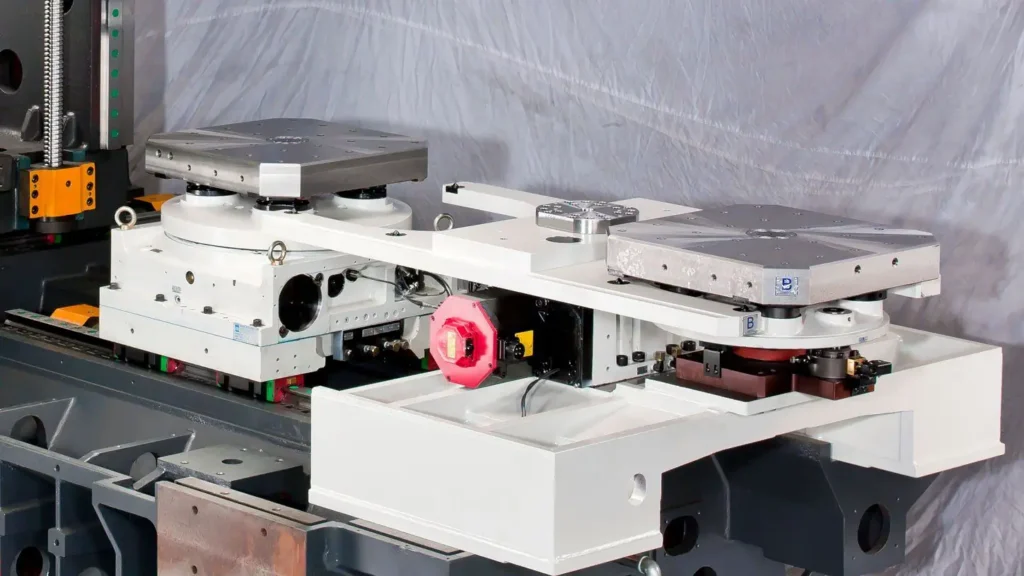
An Automatic Pallet Changer (APC) is a mechanized system integrated into CNC machining centers most commonly Horizontal Machining Centers (HMCs) that allows for the automatic exchange of workholding pallets between the machine’s cutting zone and an external staging area. Think of it as a robotic valet for your workpieces: while one pallet is being machined, another can be prepped, loaded, and queued up for the next cycle.
The core idea? Eliminate idle time.
Without an APC, operators must manually unload finished parts and load new blanks — a process that can take minutes per cycle. Multiply that across hundreds of parts or multiple shifts, and you’ve lost hours of potential production time. With an APC, that downtime vanishes. The machine swaps pallets in seconds, often while the spindle is still retracting or coolant is draining.
2. How Does an APC Work?
Most APC systems follow a similar operational flow:
- Machining Completes : The CNC finishes its programmed operations on the current pallet.
- Door Opens / Guard Retracts : Safety interlocks ensure the area is clear.
- Pallet Exchange : A shuttle, rotary table, or linear transfer mechanism slides the finished pallet out and brings a fresh, pre-loaded pallet in.
- Clamping & Locating : High-precision hydraulic or mechanical clamps secure the new pallet with repeatability down to microns.
- Cycle Resumes : The CNC begins the next job automatically.
APC systems come in various configurations:
- 2-Pallet Systems : The most common. One inside the machine, one outside for setup.
- 4-Pallet or 6-Pallet Systems : Often rotary or carousel-style, allowing multiple setups to be queued.
- Pallet Pools : Larger systems with 10+ pallets managed by automated guided vehicles (AGVs) or rail systems common in lights-out “factory of the future” setups.
The pallets themselves are precision-ground, hardened steel platforms with standardized locating pins and clamping interfaces (like HSK or proprietary systems), ensuring sub-0.005mm repeatability.
3. Why Your Shop Needs an APC
a. Maximize Machine Uptime
APCs can increase machine utilization from 40–60% (manual loading) to over 90%. That’s more parts, more revenue, and faster ROI.
b. Enable Unattended / Lights-Out Machining
Load multiple pallets before lunch or at the end of the shift let the machine run overnight. No operator needed.
c. Reduce Labor Costs
One operator can manage multiple APC-equipped machines, or focus on higher-value tasks like programming or inspection.
d. Improve Setup Consistency
Manual setups introduce human error. Pallets are repeatable, reducing scrap and rework.
e. Safer Work Environment
Operators never enter the machining zone during cutting reducing risk of accidents.
f. Flexible for High-Mix, Low-Volume
Even if you’re not running 10,000 of the same part, APCs let you queue different jobs on different pallets and switch between them with minimal downtime.
4. Top Brands Offering APC Systems
When investing in an APC, you’re often buying it as part of a complete machining center though some retrofit solutions exist. Here are the most trusted and widely used brands in the global CNC market:
a. Mazak
- Flagship Models: HCN Series, INTEGREX Series
- APC Feature: “Smooth Pallet Changer” with 2–6 pallet options, integrated with MAZATROL SmoothX CNC.
- Why It’s Popular: Ultra-fast pallet change (as low as 6 seconds), seamless integration, and legendary reliability.
b. Okuma
- Flagship Models: MB Series, MCR Series
- APC Feature: “Thermo-Friendly” APC design that compensates for thermal expansion during long runs.
- Why It’s Popular: Built for 24/7 unattended operation; Okuma’s “OSP” control offers deep APC scheduling and monitoring.
c. DMG MORI
- Flagship Models: NHX Series, DMC H Series
- APC Feature: “PH 150/200” pallet handling systems, compatible with CELOS digital manufacturing platform.
- Why It’s Popular: Modular design, supports up to 12 pallets, strong European and North American presence.
d. Haas Automation
- Flagship Models: EC-400, UMC-750 (with optional pallet systems)
- APC Feature: “Haas High-Speed Pallet Changer” affordable, compact, ideal for small to mid-sized shops.
- Why It’s Popular: Cost-effective entry into automation; simple interface, widely supported.
e. Doosan Machine Tools
- Flagship Models: DNM Series, Puma Series
- APC Feature: “Twin Pallet Changer” standard on many HMCs; optional expandable systems.
- Why It’s Popular: Strong value proposition, robust build, excellent service network.
f. Makino
- Flagship Models: A500Z, A61 HMCs
- APC Feature: “MMC2” (Multi-Modal Cell) with integrated pallet management and robotic loading.
- Why It’s Popular: Aerospace and mold/die specialists; ultra-high precision and thermal stability.
g. Hurco
- Flagship Models: VMX Series, HC Series
- APC Feature: “WinMax” control with intuitive pallet scheduling; optional 2-pallet systems.
- Why It’s Popular: User-friendly interface, great for shops transitioning into automation.
h. FANUC Robomachine
- Flagship Models: ROBODRILL, ROBOSHOT (with optional pallet systems)
- APC Feature: Compact pallet changers designed for high-speed, high-precision applications.
- Why It’s Popular: Ideal for medical, electronics, and small-part manufacturing.
5. Pro Tips for Implementing an APC
- Start Small : A 2-pallet system is often enough to double your productivity. Expand later.
- Standardize Workholding : Use modular fixturing (like vises, tombstones, or modular pallet fixtures) to reduce setup time.
- Train Your Team : Operators should know how to load pallets safely and efficiently. Programmers must understand pallet offsets and scheduling.
- Integrate with Tool Management : Use tool presetter and automatic tool changers (ATC) to complement your APC for true unattended runs.
- Monitor with IoT : Modern APCs can feed data to dashboards track cycle times, pallet usage, and machine health.
6. Real-World Impact: A Case Study Snapshot
A mid-sized aerospace supplier in Ohio upgraded from a vertical machining center (VMC) to a Mazak HCN-5000 with 2-pallet APC. Before: 12-hour days, 1 operator per machine, 60% utilization. After: 24/7 operation, 1 operator managing 3 machines, 92% utilization. ROI: 14 months. Annual output increased by 220%.
7. The Future of APCs
As Industry 4.0 advances, APCs are becoming smarter:
- AI-Powered Scheduling : Systems that auto-optimize job sequence based on tool wear, delivery dates, or energy costs.
- Integrated Robotics : Collaborative robots (cobots) loading/unloading pallets from carts or conveyors.
- Cloud Monitoring : Remote diagnostics and pallet tracking via cloud platforms.
- Modular Pallet Systems : Plug-and-play pallets that auto-identify part programs and fixtures via RFID or QR codes.
8. Final Thoughts
An Automatic Pallet Changer isn’t just a “nice-to-have” accessory it’s a strategic productivity multiplier. Whether you’re looking to cut labor costs, run overnight, or simply get more parts out the door with less stress, an APC delivers tangible, measurable ROI.
The top brands Mazak, Okuma, DMG MORI, Haas, Doosan, Makino, Hurco, and FANUC offer proven, reliable systems tailored to every shop size and budget. Don’t think of an APC as an expense. Think of it as your machine’s shift partner the one who never calls in sick, never takes a break, and always shows up on time.
9. Ready to Automate?
Talk to your machine tool distributor. Ask for an APC demo. Calculate your potential ROI. The future of efficient, competitive manufacturing is automated and it starts with a simple pallet swap.
Have questions about retrofitting an APC or choosing the right brand for your application? Drop a comment below or contact us for a free consultation.


