
In the fast-paced world of modern manufacturing, efficiency, precision, and automation are no longer optional they’re essential. One of the most transformative innovations in Computer Numerical Control (CNC) machining is the Automatic Tool Changer, or ATC. Whether you’re a machinist, engineer, shop owner, or student diving into CNC technology, understanding ATC systems is critical to maximizing productivity and staying competitive.
A- What is an Automatic Tool Changer (ATC)?
An Automatic Tool Changer (ATC) is a robotic mechanism integrated into CNC machines primarily machining centers like vertical and horizontal mills that automatically swaps cutting tools during a machining cycle without human intervention. Instead of stopping the machine, opening the door, and manually changing tools (a time-consuming and error-prone process), the ATC seamlessly retrieves the next required tool from a storage magazine and installs it into the spindle.
Think of it as a robotic assistant inside your CNC machine always ready, always accurate, and always on time.
B- Why Was ATC Developed?
Before ATC systems, CNC machines were limited in functionality. Operators had to:
- Pause the machine.
- Manually remove the current tool.
- Install the next tool.
- Re-zero or re-calibrate if necessary.
- Restart the program.
This not only slowed production but introduced variability and potential for human error. As manufacturing demands grew more complex requiring multiple operations like drilling, milling, boring, and tapping on a single workpiece the need for uninterrupted, multi-tool machining became urgent.
Enter the ATC born from the need for speed, consistency, and unattended operation.
C- How Does an ATC Work? (Step-by-Step)
Let’s break down a typical ATC tool change cycle. Most modern ATCs follow this sequence:
Step 1: Tool Change Command
The CNC program issues a tool change command usually Txx M06 in G-code, where Txx specifies the tool number (e.g., T05 for tool #5).
Step 2: Spindle Positioning
The machine moves the spindle to a pre-programmed “tool change position” often near the tool magazine to align with the ATC arm.
Step 3: Tool Release
The spindle releases the current tool using a drawbar mechanism (typically hydraulic or pneumatic). The tool drops slightly but is caught by the ATC arm.
Step 4: Tool Swap
The ATC arm often a double-ended gripper rotates 180 degrees. One end holds the old tool; the other retrieves the new tool from the magazine.
Step 5: Tool Insertion
The new tool is inserted into the spindle, and the drawbar clamps it securely.
Step 6: Tool Return
The old tool is returned to its designated slot in the magazine.
Step 7: Resume Machining
The machine resumes operation with the new tool. Tool length offset (via G43 Hxx) is often applied automatically.
⏱️ The entire process can take as little as 2–8 seconds, depending on the machine and ATC design.
D- Key Components of an ATC System
Understanding the anatomy of an ATC helps you appreciate its engineering and maintain it effectively.
1. Tool Magazine
This is the storage unit for tools. Magazines come in two main types:
- Drum (Turret) Type : Circular, holds 10–30 tools. Compact, fast rotation. Ideal for small to medium shops.
- Chain Type : Linear or oval chain loop, holds 30–120+ tools. Slower but scalable. Common in large production environments.
2. ATC Arm (Tool Changer Arm)
A robotic arm, often double-gripped, that physically moves tools between the spindle and magazine. It may rotate, extend, or pivot depending on design.
3. Spindle & Tool Interface
The spindle must have an automatic tool release mechanism (e.g., ISO, CAT, BT, or HSK taper standards) and a drawbar to clamp/unclamp tools.
4. Control System
The CNC controller coordinates the entire tool change sequence timing, positioning, sensor feedback, and error handling.
5. Sensors & Safety Systems
Proximity sensors, limit switches, and sometimes RFID or barcode readers ensure the correct tool is selected and loaded. Collision detection and tool breakage sensors may also be integrated.
6. Tool Presetter (Optional but Recommended)
An offline or onboard device that measures tool length and diameter before loading into the magazine critical for precision and avoiding crashes.
E- Benefits of Using an ATC
Why invest in a machine with ATC? Here’s why it’s a game-changer:
1. Massive Time Savings
Manual tool changes can take minutes. ATCs do it in seconds. Over hundreds of cycles, this adds up to hours even days of saved production time.
2. Unattended / Lights-Out Manufacturing
With ATC + pallet changers + probing systems, CNC machines can run overnight or over weekends without an operator maximizing ROI and throughput.
3. Improved Accuracy & Repeatability
Human error in tool setting? Gone. ATCs load tools in the exact same position every time. Paired with automatic tool offset compensation, precision is guaranteed.
4. Multi-Operation Flexibility
One setup. Multiple tools. Complex parts can be fully machined front, back, holes, threads, contours without removing the part from the vise.
5. Reduced Labor Costs
Fewer operators needed per machine. One skilled machinist can oversee multiple ATC-equipped CNCs.
6. Tool Life & Inventory Management
Advanced ATCs can track tool usage, alert for wear or breakage, and even rotate tools to balance wear extending tool life and reducing waste.
F- Where Are ATCs Used?
ATCs are standard in:
- CNC Vertical Machining Centers (VMCs)
- CNC Horizontal Machining Centers (HMCs)
- Multi-Axis CNC Mills (4-axis, 5-axis)
- High-Speed Machining Centers
- Flexible Manufacturing Systems (FMS)
Industries relying heavily on ATC-equipped machines include:
- Aerospace : Complex turbine blades, structural components.
- Automotive : Engine blocks, transmission cases, prototypes.
- Medical : Implants, surgical instruments requiring high precision.
- Mold & Die : Intricate cavities needing multiple finishing tools.
- Defense & Energy : High-tolerance, durable components.
G- Types of ATC Systems
Not all ATCs are created equal. Your choice depends on your production volume, part complexity, and budget.
1. Drum-Type ATC
- Capacity: 10–30 tools
- Speed: Very fast (2–4 seconds/tool)
- Footprint: Compact
- Best For: Small shops, low-mix high-volume parts, educational use
2. Chain-Type ATC
- Capacity: 30–120+ tools
- Speed: Slower (5–10 seconds/tool)
- Footprint: Larger, often behind or beside the machine
- Best For: High-mix production, complex parts, aerospace/automotive
3. Robotic ATC (Emerging)
- Uses a 6-axis collaborative robot to fetch tools from external racks.
- Highly flexible, scalable, and can service multiple machines.
- Ideal for lights-out factories and Industry 4.0 integration.
4. Umbrella-Type ATC is a Shop Favorite
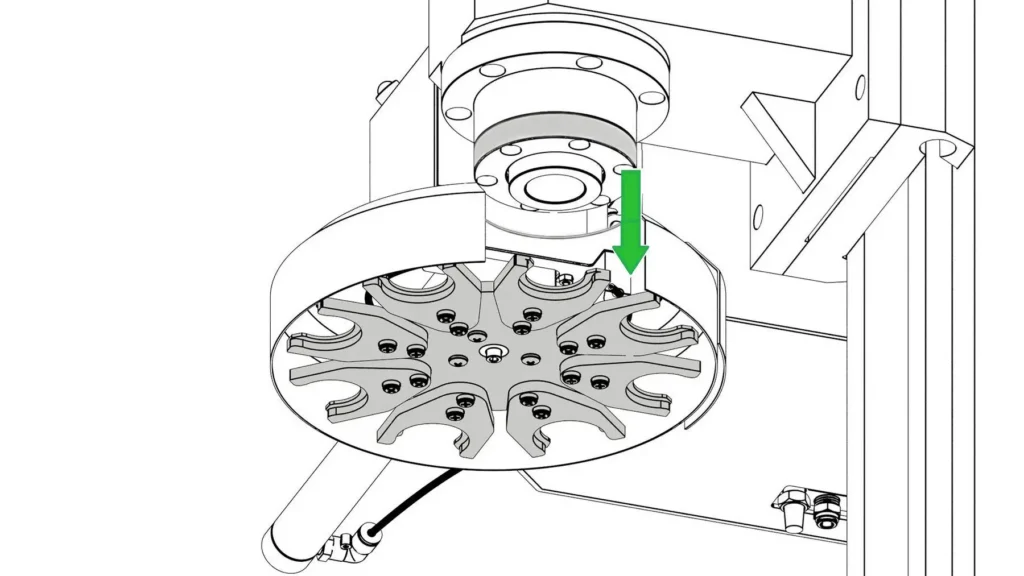
Ask any seasoned machinist or shop floor manager, and they’ll tell you: when it comes to balancing speed, simplicity, and cost, few systems beat the umbrella-type ATC. Its intuitive circular layout means operators can visually track tool positions at a glance, reducing setup errors and speeding up changeovers. For small to medium-sized manufacturers especially job shops juggling custom parts and quick-turn orders this ATC design delivers just enough capacity without overcomplicating the machine or blowing the budget. It’s the reliable workhorse hiding in plain sight: no flashy robotics or sprawling chains, just solid, repeatable performance that keeps the spindle spinning and the chips flying. In an industry where uptime is king, the humble umbrella-type ATC remains one of the smartest investments you can make.

| Pos. | Description |
| 1 | Base plate |
| 2 | Plate |
| 3 | Feather key |
| 4 | Microswitch |
| 5 | Shaft |
| 6 | Rod |
| 7 | Board |
| 8 | Cover |
| 9 | Board |
| 10 | Assembly |
| 11 | Cover |
| 12 | Cover |
| 13 | Shaft |
| 14 | Cover |
| 15 | Cover |
| 16 | Axis |
| 17 | Bearing block |
| 18 | Ball bearing |
| 19 | Motor |
| 20 | Plate |
| 21 | Sleds |
| 22 | Holder |
| 23 | Cylinder |
| 24 | Bearing |
| 25 | Box |
H- Programming ATC: G-Code Basics
Tool changes are controlled via simple M-code command. Here’s a typical example:
O1000 (Sample Program with ATC)
G90 G54 G17 G40 G49 G80 (Safe startup)
G00 G43 H01 Z100. (Rapid to safe Z, apply tool #1 offset)
M03 S2000 (Spindle on CW, 2000 RPM)
...
T02 M06 (Prepare and change to Tool #2)
G43 H02 (Apply length offset for Tool #2)
...
T03 M06 (Change to Tool #3)
G43 H03
...
M30 (End program)- Txx = Tool Select
- M06 = Tool Change Command
- Hxx = Tool Length Offset Register
Modern CAM software (like Mastercam, Fusion 360, or SolidCAM) automatically generates these commands based on your toolpath strategy.
I- Maintenance & Troubleshooting Tips
ATCs are robust but not invincible. Poor maintenance leads to downtime. Here’s how to keep yours running smoothly:
Daily Checks:
- Clean chips from magazine and ATC arm.
- Check for loose tools or damaged grippers.
- Listen for unusual noises during tool change.
Weekly/Monthly:
- Lubricate ATC arm rails and pivot points.
- Inspect tool retention knobs and tapers for wear.
- Verify tool alignment in magazine slots.
Common Issues & Fixes:
- Tool not releasing? Check air/hydraulic pressure, drawbar force.
- Wrong tool loaded? Verify tool table in CNC; check sensors.
- ATC arm collision? Re-home machine; check tool magazine alignment.
- Slow tool change? Lubricate; check for mechanical binding.
💡 Pro Tip: Always keep a manual tool change procedure handy in case of ATC failure — don’t let one breakdown halt your entire shop.
J- Future Trends in ATC Technology
ATC systems are evolving rapidly, driven by Industry 4.0, AI, and smart manufacturing. Here’s what’s coming:
1. Smart Tool Management
RFID-tagged tools communicate usage data, wear levels, and maintenance schedules directly to the CNC or MES (Manufacturing Execution System).
2. AI-Powered Tool Selection
Machine learning algorithms suggest optimal tool sequences based on material, geometry, and historical performance reducing cycle time and tool wear.
3. Robotic Tool Changing
Instead of built-in ATC arms, external collaborative robots service multiple machines increasing flexibility and reducing machine cost.
4. Self-Calibrating Tools
Tools with embedded sensors auto-calibrate length and runout upon loading eliminating setup errors.
5. Cloud-Connected ATCs
Remote monitoring, predictive maintenance alerts, and tool inventory synced to cloud platforms accessible from your phone or tablet.
K- Cost vs. ROI: Is ATC Worth It?
Let’s be real machines with ATC cost more upfront. A basic VMC without ATC might cost $50,000. The same machine with a 24-tool ATC? $70,000–$90,000.
But consider the ROI:
- Labor Savings: One operator runs 3 machines instead of 1.
- Overtime Reduction: No need to pay for manual changeovers.
- Scrap Reduction: Fewer human errors = less wasted material.
- Capacity Boost: 30–50% more parts per shift.
In most cases, the ATC pays for itself within 6–18 months especially in high-mix or high-volume environments.
L- ATC in Education & Training
For technical schools and training centers, ATC-equipped CNC machines offer students real-world experience. Learning to:
- Program tool changes
- Set up tool offsets
- Diagnose ATC errors
- Manage tool libraries
prepares students for modern manufacturing floors where ATC is the norm, not the exception.
Many schools now use simulators (like CNC Simulator Pro or VERICUT) to teach ATC concepts safely before touching real machines.
M- Final Thoughts: ATC is Not Optional It’s Essential
The Automatic Tool Changer is more than a convenience it’s a cornerstone of modern CNC machining. It transforms a good machine into a powerhouse of productivity. Whether you’re machining one-off prototypes or running 24/7 production, ATC gives you the edge.
As manufacturing becomes more automated, connected, and intelligent, ATC systems will only grow smarter, faster, and more integrated. Ignoring ATC is like driving a race car in first gear you’re leaving performance on the table.
N- Checklist: Is Your Shop Ready for ATC?
☐ Do you perform multiple operations per part?
☐ Are manual tool changes slowing you down?
☐ Do you want to run machines unattended?
☐ Are you losing money due to setup errors or downtime?
☐ Are you planning to scale production in the next 2 years?
If you answered “Yes” to any of these it’s time to embrace ATC.
O- Got Questions?
Whether you’re selecting your first ATC machine, troubleshooting a tool changer, or planning a full FMS drop your questions below. The future of manufacturing is automatic, intelligent, and incredibly exciting and ATC is leading the charge.


