
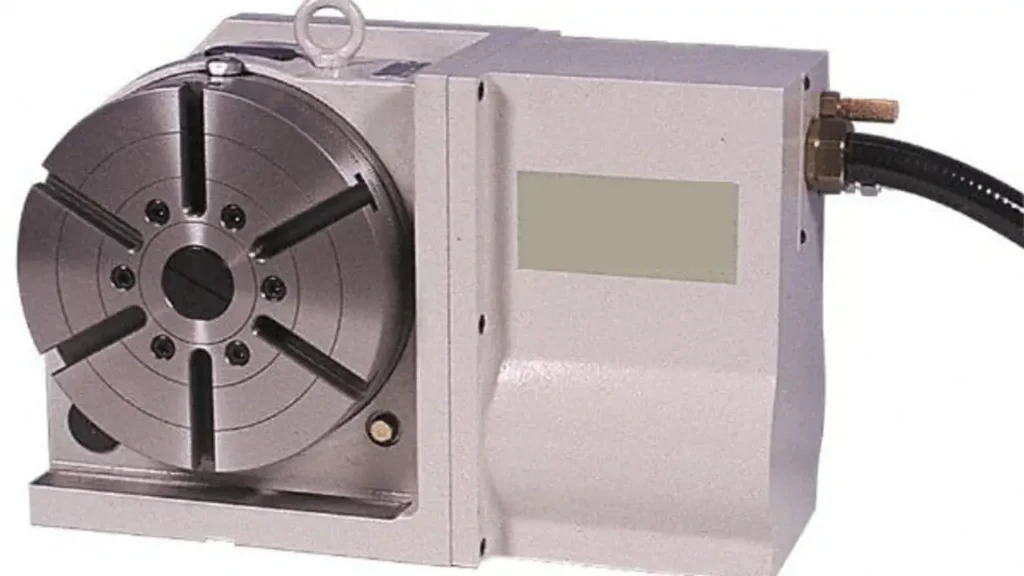
In the ever-evolving world of precision manufacturing, the demand for complex, high-accuracy parts continues to grow. From aerospace components to intricate medical devices, modern industries require machining solutions that go beyond the standard three linear axes (X, Y, and Z). Enter the CNC rotary table powerful accessory that transforms a conventional 3-axis CNC machine into a versatile 4- or even 5-axis machining center. In this blog post, we’ll explore what a CNC rotary table is, how it works, its key benefits, applications, and considerations for selecting the right one for your shop.
What Is a CNC Rotary Table?
A CNC rotary table is a precision rotary positioning device that mounts onto a CNC milling machine or machining center. It rotates a work piece around a single axis typically the A-axis (rotation around the X-axis) or the B-axis (rotation around the Y-axis)—enabling multi-sided machining without manual repositioning. Controlled directly by the machine’s CNC system, the rotary table allows for highly accurate angular positioning, continuous rotation for contouring, and synchronized motion with the machine’s linear axes.
Think of it as adding a “fourth dimension” to your machining capabilities. Instead of clamping a part, machining one face, unclamping, rotating manually, and repeating a time-consuming and error-prone process a CNC rotary table automates this rotation with micron-level precision.
How Does a CNC Rotary Table Work?
At its core, a CNC rotary table consists of a rotating platform driven by a precision motor (often a servo or stepper motor) and a high-accuracy gearbox or direct-drive system. The rotation is controlled by the CNC controller through G-code commands, just like the linear axes.
Key components include:
- Rotary Drive Mechanism: This can be worm gear, harmonic drive, or direct-drive. Worm gears are common for their high torque and self-locking ability; direct-drive systems offer superior speed and accuracy but at a higher cost.
- Indexing Accuracy: High-end tables achieve positioning accuracy within a few arc-seconds, critical for aerospace and optical applications.
- Hydraulic or Pneumatic Clamping: Many tables feature automatic clamping to lock the table in place during heavy cutting operations, preventing unwanted movement.
- Hollow Bore or Through-Hole Design: Allows for coolant delivery, tool access, or fixturing flexibility.
- Encoder Feedback: Integrated encoders provide real-time position feedback to the CNC, enabling closed-loop control for precise angular movements.
When integrated into a CNC program, the rotary table can perform operations like:
- Indexing to precise angles for drilling or milling on multiple faces.
- Continuous 4-axis contouring (e.g., helical flutes on a drill bit).
- Synchronized motion with linear axes for complex 3D surfaces.
Types of CNC Rotary Tables
Not all rotary tables are created equal. The right choice depends on your application, budget, and machine compatibility.
- Standard Indexing Tables: These offer discrete angular positioning (e.g., 90°, 45°, 30° increments) and are ideal for simple multi-sided parts. They’re cost-effective but lack continuous rotation capability.
- Fully Contouring (Continuous) Rotary Tables: These support infinite rotation and synchronized motion with other axes. Essential for 4-axis profiling and complex geometries.
- Tilting Rotary Tables (4+1 or 5-Axis): Combine rotation with tilt (e.g., A- and C-axes), enabling true 5-axis machining on a 3-axis machine. These are more complex and expensive but offer maximum flexibility.
- Palletized Rotary Tables: Used in high-volume production, these allow for quick part changeover using standardized pallets ideal for lights-out manufacturing.
- Compact vs. Heavy-Duty: Compact tables suit small parts and lighter cuts; heavy-duty versions handle large, dense materials like titanium or Inconel with high torque and rigidity.
Key Benefits of Using a CNC Rotary Table
- Reduced Setup Time: Eliminate manual re-clamping and realignment. Machine all sides of a part in a single setup, drastically cutting cycle times.
- Improved Accuracy and Repeatability: Manual repositioning introduces human error. A CNC rotary table ensures each face is machined with consistent datum references, enhancing part quality.
- Enhanced Geometric Complexity: Create helical features, curved slots, cam profiles, and contoured surfaces that would be impossible or extremely difficult on a 3-axis machine alone.
- Better Surface Finish: Continuous 4-axis motion allows for smoother tool paths and optimal tool engagement, reducing chatter and improving finish.
- Cost-Effective Multi-Axis Machining: Investing in a rotary table is far more affordable than purchasing a full 5-axis machining center, making advanced capabilities accessible to small and mid-sized shops.
- Increased Machine Utilization: With automated multi-sided machining, your CNC can run longer unattended, boosting productivity and ROI.
Common Applications
CNC rotary tables are used across a wide range of industries:
- Aerospace: Machining turbine blades, impellers, and structural brackets with complex airfoil geometries.
- Automotive: Producing camshafts, transmission components, and custom engine parts.
- Mold & Die: Creating intricate cores, cavities, and electrodes with undercuts and curved surfaces.
- Medical: Manufacturing surgical instruments, orthopedic implants, and dental prosthetics requiring high precision.
- Energy: Fabricating valve bodies, pump housings, and connectors with multiple ports and angles.
- Prototyping & Job Shops: Enabling flexible, low-volume production of custom parts without dedicated fixtures.
For example, consider a hydraulic manifold block with ports on five sides. Without a rotary table, you’d need five separate setups. With one, the part is fixtured once, and the table indexes to each face automatically saving hours of labor and ensuring perfect alignment between ports.
Integration with CNC Machines
Integrating a rotary table requires both hardware and software considerations:
Hardware:
- Ensure your CNC machine has an available axis output (often a 4th or 5th axis port).
- Verify compatibility with your control system (Fanuc, Siemens, Heidenhain, etc.).
- Check table dimensions and weight to ensure your machine’s table can support it.
- Consider coolant and air line routing if the table requires external services.
Software:
- Your CAM software must support 4- or 5-axis programming (e.g., Mastercam, Fusion 360, SolidCAM).
- Post-processors need to be configured to output correct G-code for rotary motion (e.g., G68.2 for Fanuc 4-axis rotation).
- Simulation is critical to avoid collisions between the tool, table, and workpiece.
Many modern CNC controls support “RTCP” (Rotational Tool Center Point) or similar functions, which automatically compensate for tool length and rotary center offsets simplifying programming and improving accuracy.
Choosing the Right CNC Rotary Table
Selecting the best rotary table involves evaluating several factors:
- Accuracy Requirements: High-precision applications (e.g., optics) demand tables with <10 arc-second repeatability. General machining may tolerate ±30 arc-seconds.
- Torque and Load Capacity: Match the table’s holding torque and maximum load to your heaviest workpieces and most aggressive cuts.
- Table Diameter: Larger diameters offer more fixturing space but may limit travel on smaller machines.
- Drive Type: Worm gear for cost and torque; direct-drive for speed and precision.
- Clamping Mechanism: Hydraulic clamping is essential for heavy milling; manual or pneumatic may suffice for light drilling.
- Through-Hole Size: A larger bore allows for internal tooling or coolant delivery.
- Brand and Support: Reputable manufacturers (e.g., Techno, Röders, Nikken, Kitagawa) offer reliability, calibration certificates, and technical support.
Budget is always a consideration, but remember: a high-quality rotary table is a long-term investment. A poorly made table can introduce vibration, backlash, or drift—compromising your entire machining process.
Maintenance and Best Practices
To ensure longevity and performance:
- Lubricate regularly according to the manufacturer’s schedule, especially worm gear systems.
- Keep chips and coolant out of the rotary mechanism using bellows or covers.
- Check for backlash periodically and adjust if possible.
- Calibrate annually using a precision rotary encoder or laser interferometer.
- Avoid overloading the table beyond its rated capacity.
- Use proper fixturing to minimize overhang and vibration.
The Future of Rotary Tables
As manufacturing pushes toward greater automation and complexity, rotary tables are evolving too. Trends include:
- Integrated servo motors for faster acceleration and higher resolution.
- Smart tables with built-in sensors for real-time monitoring of temperature, load, and wear.
- Modular designs that allow quick swapping between different table types.
- Enhanced compatibility with Industry 4.0 systems for predictive maintenance and data logging.
Moreover, as CAM software becomes more intuitive and affordable, even small shops can harness the power of 4- and 5-axis machining without extensive training.
Final Thoughts
A CNC rotary table is more than just an accessory—it’s a gateway to advanced manufacturing capabilities. By enabling multi-sided, high-precision machining in a single setup, it boosts productivity, improves part quality, and expands the range of parts you can profitably produce. Whether you’re a job shop looking to win more complex contracts or a production facility aiming to reduce cycle times, investing in a quality rotary table can deliver significant returns.
Before making a purchase, assess your typical work pieces, machine capabilities, and long-term goals. Consult with your machine tool dealer or rotary table manufacturer—they can often provide application-specific recommendations and even demo units.
In a world where “good enough” is no longer sufficient, the CNC rotary table empowers you to machine smarter, faster, and with unparalleled precision. Embrace the fourth axis, and unlock the full potential of your CNC machine.
Have you integrated a rotary table into your shop? Share your experiences or questions in the comments below!


