
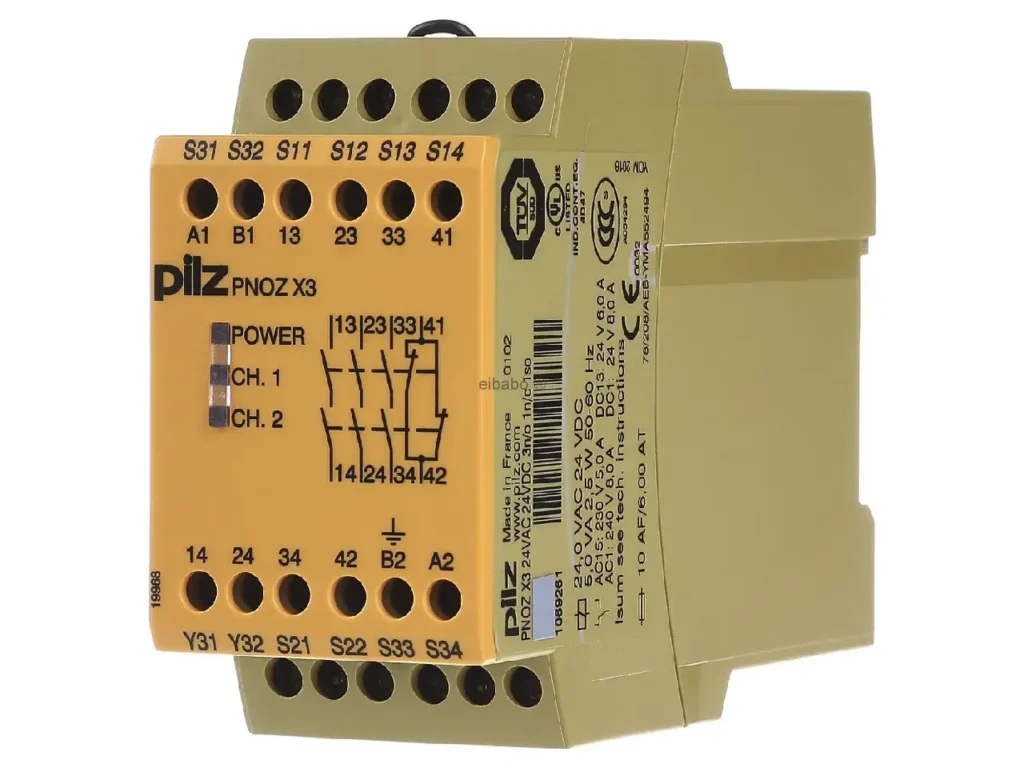
In the world of industrial automation, Computer Numerical Control (CNC) machines are the backbone of precision manufacturing. From milling and turning to laser cutting and 3D printing, CNC systems deliver consistent, high-quality output with minimal human intervention. However, with such powerful and fast-moving machinery comes significant risk both to the equipment itself and, more importantly, to the operators who work alongside it. To mitigate these risks, modern CNC electrical cabinets incorporate a range of safety components, among which the safety relay plays a pivotal role.
This blog post explores the function, design, integration, and importance of safety relays in CNC electrical cabinets, highlighting why they are indispensable in today’s industrial environments.
What Is a Safety Relay?
A safety relay is a specialized electromechanical or electronic device designed to monitor safety circuits and ensure that a machine enters a safe state when a hazardous condition is detected. Unlike standard control relays, safety relays are engineered to meet stringent international safety standards (such as IEC 62061, ISO 13849-1, and EN 60204-1) and incorporate redundant internal architectures to prevent dangerous failures.
In a CNC machine context, safety relays are typically used to monitor inputs from emergency stop (E-stop) buttons, safety interlocks on access doors, light curtains, safety mats, and other protective devices. When any of these devices are activated say, an operator presses the E-stop the safety relay immediately cuts power to critical machine functions, such as spindle motors, axis drives, and hydraulic systems, bringing the machine to a controlled stop.
Why Standard Relays Aren’t Enough
At first glance, one might wonder: why not use a regular relay for safety functions? After all, both types can switch electrical loads. The answer lies in reliability and fail-safe design.
Standard relays lack the internal redundancy and diagnostic capabilities required for safety-critical applications. For example, if a standard relay’s contacts weld together due to arcing or overload a common failure mode the machine might remain energized even when the E-stop is pressed, creating a life-threatening situation.
Safety relays, by contrast, employ dual-channel monitoring with cross-checking logic. They often contain two or more independent contact sets that must agree on the machine’s state. If a discrepancy is detected (e.g., one channel opens while the other remains closed), the relay enters a safe state and prevents restart until the fault is resolved. Many modern safety relays also include self-monitoring circuits that continuously check for internal faults, ensuring that the device itself doesn’t become a point of failure.
Key Functions of Safety Relays in CNC Cabinets
In a typical CNC electrical cabinet, the safety relay serves several critical functions:
1. Emergency Stop Monitoring
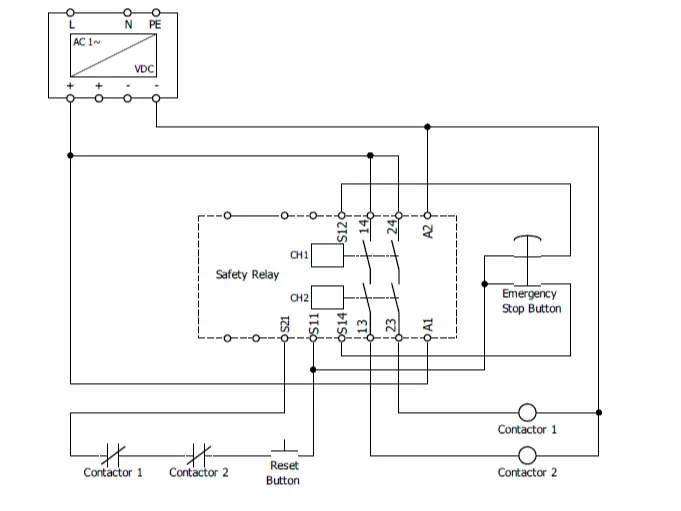
The most common application is monitoring the E-stop circuit. When an E-stop button is pressed anywhere on the machine, the safety relay de-energizes the main contactor or safety contactor that powers the machine’s drives and motors. This action is immediate and irreversible until the E-stop is manually reset and the safety relay is reset often requiring a deliberate two-step process to prevent accidental restarts.
2. Access Door Interlocking
CNC machines often have protective guards or doors that must remain closed during operation. Safety interlock switches on these doors feed into the safety relay. If a door is opened while the machine is running, the safety relay triggers a safe stop. This prevents operators from reaching into moving parts or being exposed to flying debris or coolant.
3. Integration with Light Curtains and Presence-Sensing Devices
Advanced CNC setups may use optical safety devices like light curtains. These create an invisible infrared barrier around hazardous zones. If an operator breaks the beam, the safety relay instantly halts machine motion. The relay ensures that the signal from the light curtain is interpreted correctly and that the machine cannot restart until the beam is restored and the system is reset.
4. Safe Torque Off (STO) Enable for Drives
Many modern CNC servo and spindle drives support a Safe Torque Off (STO) function, which electronically disables torque generation without cutting main power. The safety relay often controls the STO input to these drives, providing a fast, wear-free method of stopping motion while keeping the drive powered for diagnostics or quick restarts.
5. Reset and Restart Control
Safety relays enforce proper restart protocols. After a safety event, the machine cannot simply resume operation by releasing the E-stop. Instead, a separate reset signal often via a dedicated button—is required. This prevents unexpected motion and ensures the operator is aware of the machine’s state before resuming work.
Design and Architecture of Safety Relays
Safety relays come in various forms, from compact single-function units to modular systems that can monitor multiple safety inputs. Key design features include:
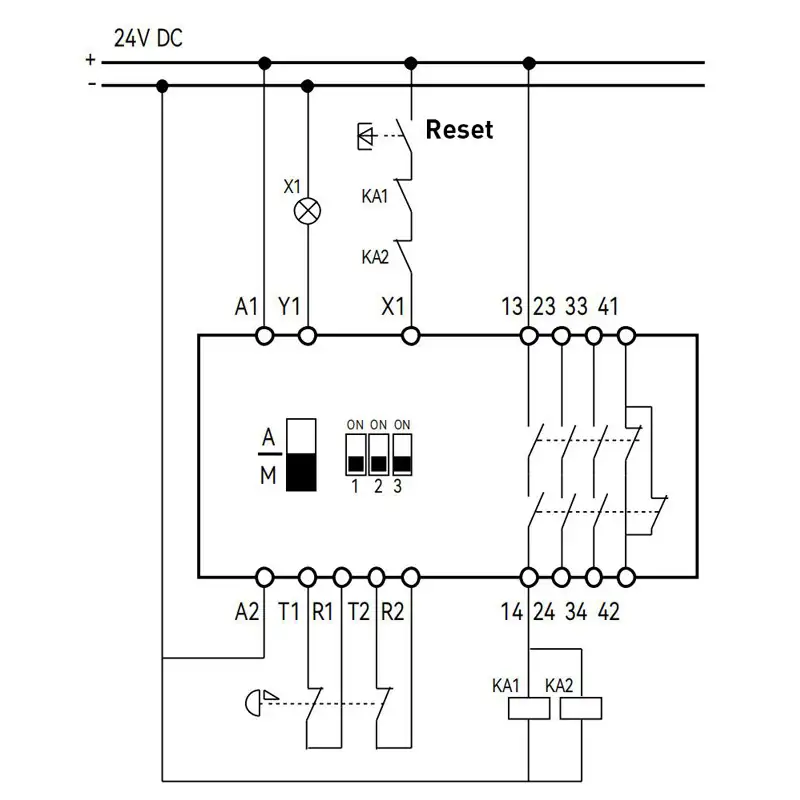
- Redundant Contact Sets: Typically two or three normally open (NO) and normally closed (NC) contacts arranged in a force-guided configuration. Force-guided contacts are mechanically linked so that if one set welds shut, the others cannot close, ensuring fail-safe behavior.
- Self-Diagnostics: Internal circuits monitor for coil failures, contact welding, and wiring faults. Some relays include LED indicators to show status (e.g., “OK,” “Fault,” “Reset Required”).
- Compliance with Safety Integrity Levels (SIL) and Performance Levels (PL): Safety relays are rated according to international standards. For example, a relay might be certified for SIL 2 (per IEC 62061) or PL d (per ISO 13849-1), indicating its suitability for medium-risk applications like CNC machining.
- Modularity and Expandability: In complex CNC systems, multiple safety functions may need monitoring. Modular safety relays allow daisy-chaining or expansion modules to handle additional inputs without compromising safety integrity.
Integration into CNC Electrical Cabinets
The electrical cabinet of a CNC machine houses power supplies, PLCs, motor drives, contactors, and—critically—the safety relay. Proper integration is essential:
- Wiring Practices: Safety circuits must be wired separately from standard control circuits to avoid interference. Shielded cables and proper grounding are recommended.
- Separation from Standard Control Logic: While a PLC may handle machine sequencing, safety functions should remain hardwired through the safety relay. This “safety-by-wire” approach ensures that even if the PLC fails or is reprogrammed incorrectly, the safety system remains intact.
- Clear Labeling and Documentation: All safety-related components, including the relay, its inputs, and outputs, must be clearly labeled. Electrical schematics should distinguish safety circuits from standard control circuits.
- Regular Testing and Maintenance: Safety relays should be tested periodically as part of a machine’s preventive maintenance program. Many include test buttons or diagnostic ports to verify functionality without triggering a full machine stop.
Real-World Example: Safety Relay in a CNC Milling Machine
Consider a vertical CNC milling center used in aerospace component manufacturing. The machine includes:
- Two E-stop buttons (front and rear)
- A hinged safety door with an interlock switch
- A light curtain guarding the tool-change area
- A servo-driven spindle and three-axis motion system
All these safety devices are wired into a dual-channel safety relay mounted in the main electrical cabinet. The relay’s outputs control:
- A main power contactor that cuts 3-phase power to the servo drives
- The STO inputs on each drive amplifier
During normal operation, the safety relay monitors all inputs. If an operator opens the safety door during a cycle, the interlock switch opens, and the relay immediately de-energizes the contactor and activates STO on all axes. The spindle stops, and the axes lock in place. The machine HMI displays a “Safety Door Open” message. Only after the door is closed and the operator presses the reset button does the safety relay allow the machine to restart ensuring no unexpected motion occurs.
Common Misconceptions and Pitfalls
Despite their importance, safety relays are sometimes misunderstood or misapplied:
- “The PLC Can Handle Safety”: While safety PLCs exist, using a standard PLC for safety functions is risky and often non-compliant. Hardwired safety relays provide a deterministic, fail-safe layer independent of software.
- Bypassing Safety Circuits: In high-pressure production environments, there’s temptation to bypass E-stops or door interlocks to avoid downtime. This is extremely dangerous and violates OSHA and ISO safety regulations. Properly designed safety relay systems make bypassing difficult or impossible.
- Ignoring Reset Logic: Failing to implement a proper reset sequence can lead to nuisance trips or, worse, automatic restarts after a safety event.
The Future: Smart Safety and Integration with IIoT
As Industry 4.0 and the Industrial Internet of Things (IIoT) evolve, safety relays are becoming smarter. Modern units offer:
- Communication Interfaces: Integration with fieldbus systems (e.g., PROFIsafe, CIP Safety) allows safety status to be monitored remotely.
- Predictive Diagnostics: Data on relay cycles, contact wear, and fault history can be logged for predictive maintenance.
- Cybersecurity Features: As safety systems connect to networks, secure communication protocols prevent tampering.
However, even with these advances, the core principle remains: safety must be hardware-enforced and fail-safe. Software enhancements complement but never replace the fundamental reliability of a well-designed safety relay.
Conclusion
In the high-stakes environment of CNC machining, where precision meets power, safety cannot be an afterthought. The safety relay, though often a small component in the electrical cabinet, serves as the guardian of both machine integrity and human life. By enforcing fail-safe responses to hazardous conditions, providing redundancy against component failure, and ensuring compliance with global safety standards, safety relays are a non-negotiable element of responsible machine design.
For engineers, integrators, and maintenance personnel working with CNC systems, understanding the role, selection, and proper implementation of safety relays is not just a technical requirement—it’s a moral and legal obligation. As automation continues to advance, the humble safety relay remains a cornerstone of industrial safety, quietly ensuring that every cycle runs not just efficiently, but safely.
Remember: No production target is worth compromising safety. When it comes to protecting lives, the safety relay is always on duty.


