
In the intricate tapestry of modern engineering, where precision, safety, and automation reign supreme, there exists a humble yet indispensable component that quietly ensures the smooth operation of countless systems the pressure switch. Whether you’re filling your car’s tires, operating a massive industrial compressor, or managing the water pressure in your home’s HVAC system, pressure switches are working behind the scenes to maintain equilibrium, prevent damage, and trigger critical responses.
At first glance, they may appear as simple mechanical devices with springs and diaphragms. But beneath their unassuming exteriors lies a sophisticated blend of physics, materials science, and electrical engineering. In this comprehensive guide, we’ll dive deep into the world of pressure switches exploring their principles, types, applications, selection criteria, and emerging trends to help you understand why they remain foundational elements in both industrial and consumer-grade equipment.
What Is a Pressure Switch?
A pressure switch is an electromechanical device designed to monitor fluid (liquid or gas) pressure and activate or deactivate an electrical circuit based on predefined pressure thresholds. It functions as a sensor and actuator combined detecting pressure changes and responding by opening or closing contacts to control machinery, alarms, pumps, compressors, or valves.
Unlike continuous pressure transducers that provide analog output signals proportional to pressure, pressure switches offer discrete, binary outputs: “on” or “off.” This makes them ideal for safety cutoffs, start/stop controls, and alarm triggering.
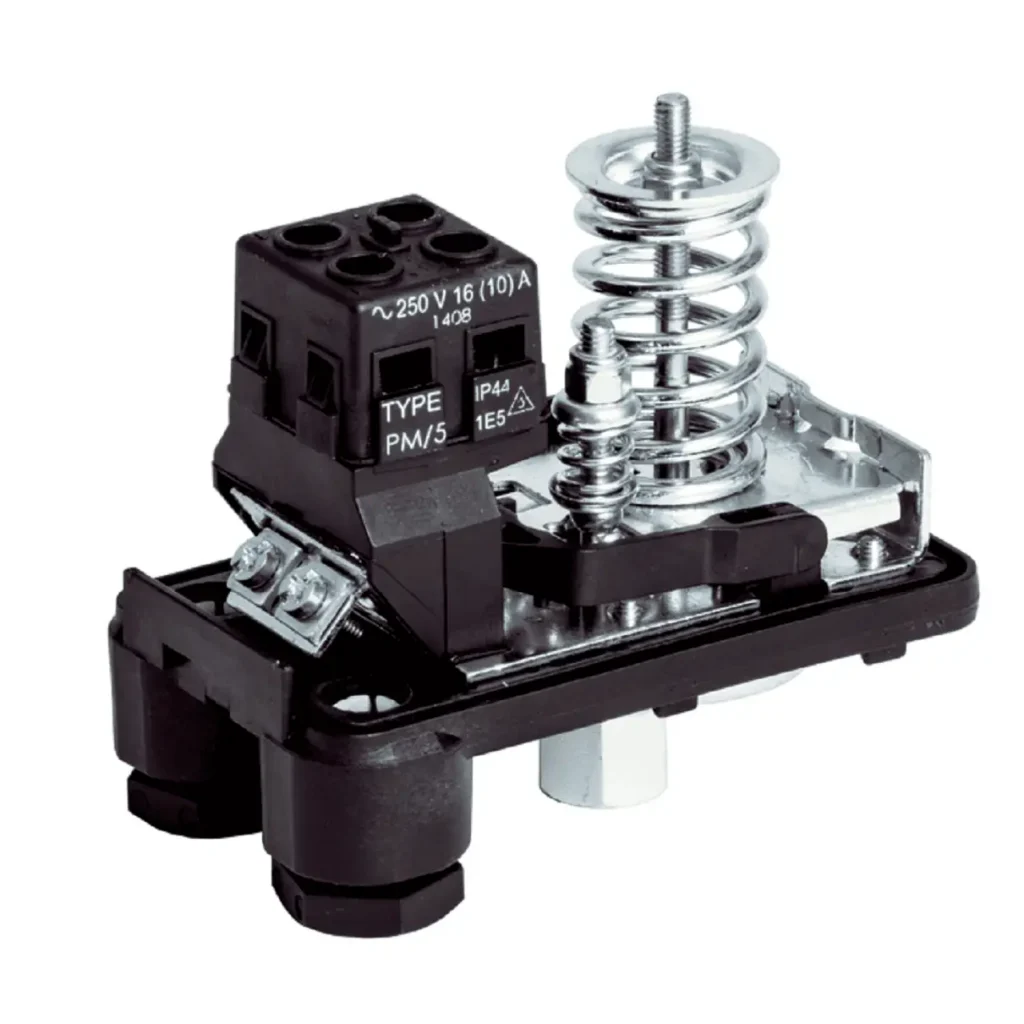
The image accompanying this article showcases a typical mechanical pressure switch compact, robust, and engineered for reliability. Notice the visible spring mechanism, the electrical terminal block rated for 250V AC and 16A, and the IP44 enclosure rating indicating protection against splashing water and dust. These features underscore its suitability for demanding environments.
How Does a Pressure Switch Work?
The fundamental principle behind most mechanical pressure switches is straightforward:
- Pressure Sensing Element: A diaphragm, piston, or bellows senses the applied pressure.
- Mechanical Actuation: As pressure rises or falls, it displaces the sensing element, which in turn moves a lever or plunger.
- Contact Activation: The movement triggers a microswitch or snap-action switch, changing the state of the electrical contacts.
- Circuit Control: The switch either completes or breaks an electrical circuit, thereby turning equipment on or off.
For example, in a household water pump system, when water pressure drops below a set point (say, 20 psi), the switch closes the circuit, activating the pump. Once pressure reaches the upper limit (e.g., 40 psi), the switch opens the circuit, shutting off the pump.
Some advanced pressure switches incorporate adjustable setpoints via calibration screws or digital interfaces, allowing users to fine-tune activation and deactivation pressures. Hysteresis the difference between the “on” and “off” points is also built-in to prevent rapid cycling near the threshold, which can cause premature wear.
Types of Pressure Switches
Pressure switches come in various configurations, each tailored to specific operational needs. Here are the most common types:
1. Mechanical Pressure Switches
These are the traditional workhorses of industry. They rely on physical components like springs, diaphragms, and levers to sense pressure. They are durable, cost-effective, and suitable for harsh environments. The unit shown in the image is a classic example featuring a spring-loaded piston mechanism and a microswitch contact assembly.
Pros: High reliability, low cost, no external power required for basic operation.
Cons: Limited accuracy, susceptible to vibration and wear over time.
2. Electronic Pressure Switches
These use solid-state sensors (often piezoresistive or capacitive) to detect pressure changes and process the signal digitally. They offer higher precision, programmable setpoints, LED indicators, and communication capabilities (e.g., Modbus, CANopen).
Pros: High accuracy, customizable settings, diagnostic feedback.
Cons: Higher cost, requires power supply, more complex installation.
3. Differential Pressure Switches
Designed to respond to the difference between two pressure inputs rather than absolute pressure. Commonly used in filter monitoring, flow detection, and HVAC systems.
4. Vacuum Pressure Switches
Specifically calibrated to operate under negative pressure (vacuum) conditions. Used in suction systems, packaging machines, and vacuum pumps.
5. High-Pressure and Low-Pressure Switches
Categorized by their operating range. High-pressure switches handle pressures from hundreds to thousands of PSI (e.g., in hydraulic systems), while low-pressure switches manage delicate applications like medical ventilators or pneumatic controls.
Key Applications Across Industries
Pressure switches are ubiquitous across sectors. Let’s explore some of their most critical uses:
HVAC Systems
In heating, ventilation, and air conditioning units, pressure switches monitor refrigerant pressure to ensure safe operation. If pressure becomes too high (indicating potential overheating or blockage), the switch shuts down the compressor to prevent catastrophic failure. Similarly, low-pressure switches protect against refrigerant leaks.
Industrial Compressors and Pumps
Air compressors and water pumps rely heavily on pressure switches to automate operation. When pressure falls below a minimum, the switch turns on the motor; when it exceeds a maximum, it shuts it off. This prevents over-pressurization and reduces energy waste.
Automotive and Transportation
Modern vehicles use pressure switches in brake systems (to detect low brake fluid), tire pressure monitoring systems (TPMS), and engine oil pressure circuits. In commercial trucks and trains, they regulate air brake systems and suspension height.
Medical Equipment
Ventilators, dialysis machines, and anesthesia units require precise pressure control. Pressure switches ensure patient safety by triggering alarms or shutdowns if pressure deviates from safe parameters.
Food & Beverage Processing
In bottling lines, pasteurizers, and CIP (clean-in-place) systems, pressure switches monitor line pressure to maintain consistent flow rates and prevent contamination or equipment damage.
Marine and Offshore
On ships and offshore platforms, pressure switches control bilge pumps, fuel transfer systems, and fire suppression systems often under extreme environmental conditions.
Home Appliances
Washing machines, dishwashers, and water heaters all contain pressure switches to manage water fill levels, detect leaks, or shut down systems during overpressure events.
Selecting the Right Pressure Switch
Choosing the appropriate pressure switch involves evaluating several technical and environmental factors:
1. Pressure Range
Select a switch whose operating range comfortably encompasses your application’s minimum and maximum pressures. Avoid operating near the extremes of the switch’s rated range to prolong lifespan.
2. Setpoint Accuracy and Hysteresis
Consider how precisely you need to control pressure. Tighter tolerances require higher-precision switches. Also, ensure adequate hysteresis to avoid chattering (rapid on/off cycling).
3. Electrical Ratings
Check the voltage and current ratings of the switch’s contacts. Ensure compatibility with your load — whether it’s a small relay coil or a heavy-duty motor starter.
4. Media Compatibility
The switch must be compatible with the fluid it will contact whether it’s air, water, oil, refrigerant, or corrosive chemicals. Materials like stainless steel, brass, or specialized elastomers (e.g., Viton, EPDM) are chosen accordingly.
5. Environmental Protection
Look for IP (Ingress Protection) or NEMA ratings that match your environment. IP44, as seen on the featured switch, protects against splashing water and dust — suitable for indoor industrial use. For outdoor or washdown applications, IP65 or higher is recommended.
6. Mounting and Connection Type
Choose between panel mount, DIN rail, or direct pipe mounting. Consider port size (NPT, BSP, metric) and electrical connection style (screw terminals, quick-connect, M12 connectors).
7. Certifications and Standards
Depending on your industry, certifications such as UL, CE, ATEX (for explosive atmospheres), or IECEx may be mandatory.
Installation and Maintenance Best Practices
Proper installation and routine maintenance are crucial to ensuring long-term reliability:
- Install in a location free from vibration, shock, or thermal cycling.
- Use proper fittings and sealants to prevent leaks.
- Avoid installing directly downstream of pumps or valves where pressure surges may occur use snubbers or accumulators if necessary.
- Regularly inspect for signs of wear, corrosion, or leakage.
- Calibrate periodically, especially in critical safety applications.
- Replace worn diaphragms, pistons, or springs according to manufacturer guidelines.
Many manufacturers offer service kits or replacement modules, making maintenance straightforward even for non-specialists.
Emerging Trends and Innovations
As Industry 4.0 and IoT reshape manufacturing and automation, pressure switches are evolving beyond simple on/off controllers:
Smart Pressure Switches
Equipped with embedded microcontrollers and communication protocols, these devices can transmit real-time data to SCADA or PLC systems. Features include remote configuration, self-diagnostics, event logging, and predictive maintenance alerts.
Wireless Pressure Switches
Ideal for retrofitting legacy systems or hard-to-reach locations, wireless switches eliminate cabling costs and simplify installation. Powered by batteries or energy harvesting, they transmit status updates via Bluetooth, LoRaWAN, or Wi-Fi.
Hybrid Analog/Digital Switches
Combining the ruggedness of mechanical switches with the intelligence of electronics, these units offer both discrete switching and continuous analog output — giving operators greater flexibility and insight.
Miniaturization and Integration
Advancements in MEMS (Micro-Electro-Mechanical Systems) technology have enabled ultra-compact pressure switches suitable for portable devices, wearable tech, and aerospace applications.
AI-Powered Predictive Analytics
In large-scale industrial plants, pressure switch data is being fed into AI models to predict failures before they occur reducing downtime and maintenance costs.
Why Pressure Switches Still Matter in the Age of Smart Sensors
You might wonder: with the proliferation of smart pressure transmitters and IIoT-enabled sensors, do traditional pressure switches still have a place?
Absolutely.
While smart sensors excel at providing granular data and analytics, pressure switches offer unmatched simplicity, reliability, and cost-effectiveness for binary control tasks. They require no software, minimal wiring, and function even during power outages (in some designs). In safety-critical applications, their fail-safe nature often mechanically driven provides an essential layer of redundancy.
Moreover, many modern systems combine both technologies: using pressure switches for immediate, local control and smart sensors for centralized monitoring and diagnostics. This hybrid approach delivers the best of both worlds robustness and intelligence.
Case Study: Preventing Catastrophic Failure in a Chemical Plant
In 2023, a chemical processing facility in Texas narrowly avoided a major incident thanks to a properly configured pressure switch. During a routine batch operation, a reactor vessel began experiencing abnormal pressure buildup due to a blocked vent line. The high-pressure switch — set to trip at 150 psi — activated within milliseconds, cutting power to the agitator motor and triggering an emergency dump valve.
Operators received an alert via the plant’s DCS system and initiated shutdown procedures. Post-incident analysis revealed that without the pressure switch’s intervention, the vessel could have ruptured, releasing hazardous chemicals and endangering personnel.
This case underscores the irreplaceable role of pressure switches in safeguarding human life and infrastructure.
Conclusion: The Unsung Heroes of Modern Engineering
Pressure switches may not grab headlines or feature in flashy product demos, but they are the silent guardians of our technological world. From the water heater in your basement to the turbines powering a nuclear plant, they ensure systems operate safely, efficiently, and reliably.
As industries continue to evolve, so too will pressure switches becoming smarter, smaller, and more integrated. Yet their core mission remains unchanged: to sense pressure, make decisions, and act decisively all without fanfare.
Whether you’re an engineer designing a new system, a technician maintaining existing equipment, or a hobbyist tinkering with home automation, understanding pressure switches empowers you to build safer, smarter, and more resilient solutions.
So next time you hear the hum of a pump kick in or feel the cool blast of your AC turn on, remember behind that seamless operation is a humble pressure switch, doing its job with quiet precision.


