
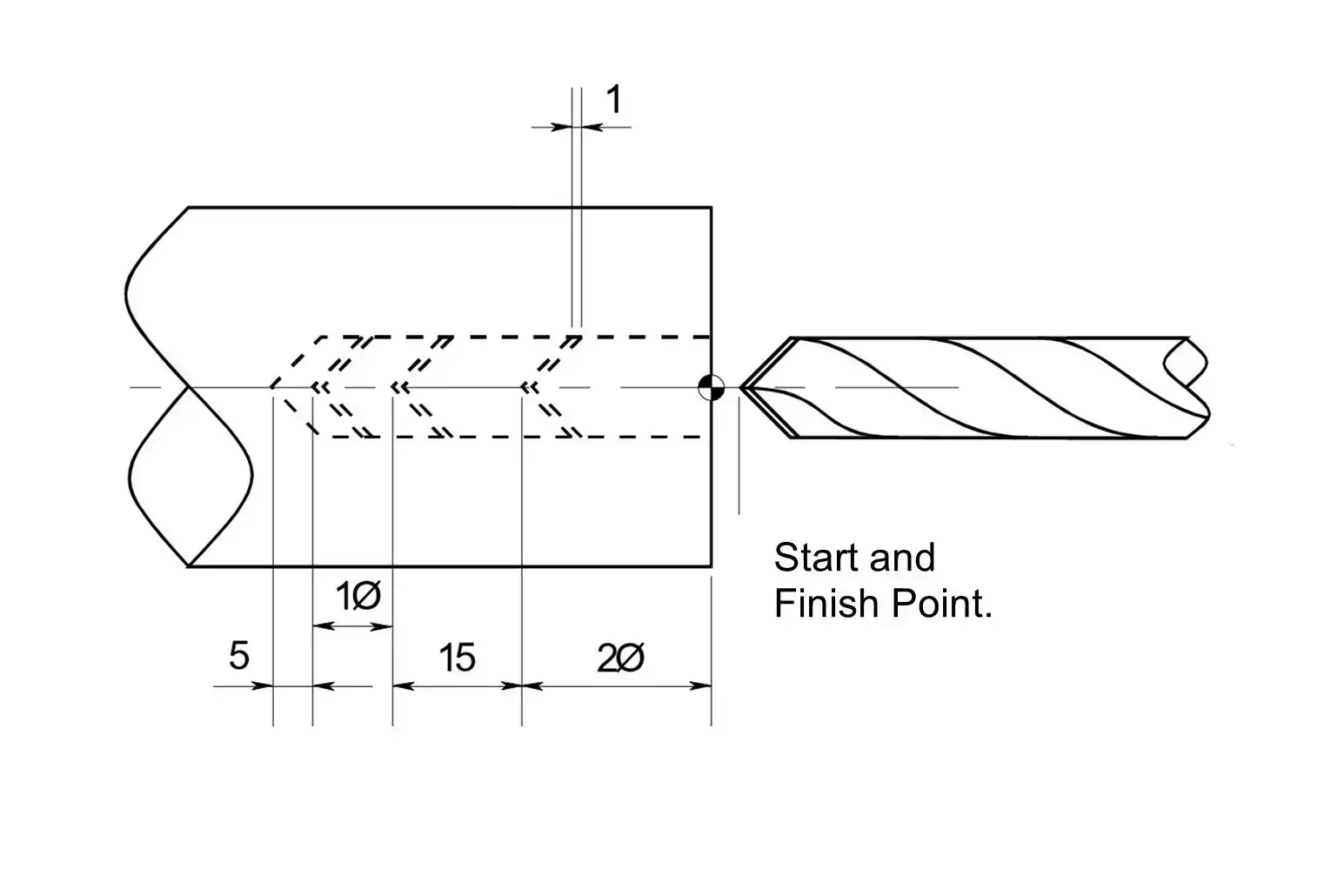
The Deep Hole Drilling Cycle is a specialized CNC machining operation used to drill deep holes in workpieces with high accuracy and efficiency. This process is often utilized in turning centers or lathes equipped with live tooling capabilities. The cycle is designed to handle the challenges associated with drilling deep holes, such as chip evacuation, heat dissipation, and maintaining straightness.
In CNC programming, deep hole drilling cycles are typically implemented using canned cycles like G83 (Peck Drilling Cycle) or other custom cycles depending on the control system. Below, we will explore how this cycle works and its key parameters.
Key Features of Deep Hole Drilling
- Intermittent Drilling (Pecking):
- To prevent chip clogging and overheating, the drill periodically retracts from the hole to allow chips to be evacuated.
- This is known as “peck drilling” and is essential for maintaining tool life and hole quality.
- Coolant/Lubrication:
- High-pressure coolant is often used to flush chips out of the hole and cool the cutting edge during deep hole drilling.
- Drill Geometry:
- Specialized drills (e.g., gun drills or BTA drills) are used for deep holes to ensure straightness and efficient chip removal.
- Feed and Speed Control:
- Feed rate and spindle speed are carefully controlled to balance material removal rate, surface finish, and tool life.
- Depth-to-Diameter Ratio:
- Deep hole drilling is typically defined as drilling where the depth-to-diameter ratio exceeds 10:1. For example, drilling a 10 mm diameter hole to a depth of 100 mm or more.
G-Code for Deep Hole Drilling (G83 Peck Drilling Cycle)
The G83 cycle is commonly used for deep hole drilling in CNC machines. It performs peck drilling by retracting the tool after each incremental cut to clear chips.
Syntax:
G83 X_ Y_ Z_ R_ Q_ F_Parameters:
- X, Y: Hole position coordinates (in absolute or incremental mode).
- Z: Final depth of the hole (absolute or incremental).
- R: Retract plane (position where the drill starts moving at rapid speed).
- Q: Peck depth (incremental depth for each drilling step).
- F: Feed rate (in mm/min or inches/min).
Example Program for Deep Hole Drilling
Let’s assume we want to drill a deep hole with the following specifications:
- Hole position: X50, Y50
- Hole depth: Z-100 (from the surface)
- Retract plane: R5 (5 mm above the surface)
- Peck depth: Q10 (drill 10 mm at a time)
- Feed rate: F200
G-Code Example:
G00 X50 Y50           ; Rapid move to hole position
G00 Z5                ; Rapid move to retract plane
G83 Z-100 R5 Q10 F200 ; Start deep hole drilling cycle
G00 Z5                ; Retract to safe height after drilling
M30                   ; End program
Steps in the Deep Hole Drilling Process
- Positioning:
- The tool moves to the hole’s starting position (X, Y coordinates).
- Initial Approach:
- The drill moves rapidly to the retract plane (R).
- Drilling with Pecking:
- The drill advances into the material by the specified peck depth (Q).
- After each peck, the drill retracts to the retract plane or slightly above to clear chips.
- Repeat Until Full Depth:
- The process repeats until the final depth (Z) is reached.
- Retraction:
- Once the hole is complete, the drill retracts to the retract plane or a safe height.
- Coolant and Chip Management:
- Coolant is continuously applied to flush chips and cool the tool.
Advantages of Using a Deep Hole Drilling Cycle
- Improved Chip Evacuation : Peck drilling ensures chips are removed regularly, preventing clogging and tool damage.
- Better Heat Dissipation : Intermittent drilling allows the tool to cool, extending tool life.
- Higher Accuracy : Controlled feed rates and peck depths result in precise hole dimensions and straightness.
- Reduced Tool Wear : By avoiding continuous cutting, the tool experiences less wear and tear.
Common Challenges and Solutions
- Chip Clogging:
- Use high-pressure coolant to flush chips out of the hole.
- Optimize peck depth (Q) to balance productivity and chip removal.
- Tool Deflection:
- Use rigid tool holders and high-quality drills designed for deep hole drilling.
- Reduce feed rate if deflection is observed.
- Heat Buildup:
- Ensure adequate coolant flow and use carbide or coated tools for better heat resistance.
- Hole Straightness:
- Use guided drills (e.g., gun drills) for very deep holes.
- Maintain consistent spindle speed and feed rate.
Applications of Deep Hole Drilling
- Aerospace Industry:
- Drilling cooling channels in turbine blades.
- Creating fuel injection nozzles.
- Automotive Industry:
- Machining engine components like crankshafts and camshafts.
- Producing hydraulic cylinders.
- Oil and Gas Industry:
- Manufacturing valves, pumps, and pipelines with deep bores.
- Medical Devices:
- Fabricating surgical instruments and implants with precision holes.
G-Code for Deep Hole Drilling (G81 deep Drilling Cycle)
The command G81 performs a deep drilling operation, where the drill retracts completely out of the hole at each peck. The definition of one of these operations is called a one pass cycle.
If a repetition of the cycle is required, only the values that change need to be entered into the next block, ie, the Z depth.

| Diameter Designation, Metric Input. Absolute | Diameter Designation, Metric Input. Incremental |
| N50 GØØ XØ.Ø Z2.Ø | N50 GØØ XØ.Ø Z2.Ø |
| N60 G81 Z-2Ø.Ø FØ.1 | N60 G81 W-22.Ø FØ.1 |
| N70 Z-35.Ø | N70 W-37.Ø |
| N80 Z-45.Ø | N80 W-47.Ø |
| N90 Z-5Ø.Ø | N90 W-52.Ø |
| N100 G80 | N100 G80 |
| N110 …. | N110…. |
Final Notes
The Deep Hole Drilling Cycle is a critical operation in CNC machining, especially for applications requiring high precision and deep bores. Proper programming, tool selection, and coolant management are essential for achieving optimal results. By leveraging canned cycles like G83, machinists can efficiently perform deep hole drilling while minimizing tool wear and ensuring high-quality outcomes.
If you have specific requirements or need further clarification, feel free to ask in comments!