
1. What is Geometric Dimensioning and Tolerancing (GD&T) ?
Geometric Dimensioning and Tolerancing (GD&T) is a standardized symbolic language used in engineering drawings and computer-generated 3D models to define the allowable variation in part geometry. It provides a precise method for specifying how parts must be manufactured and inspected, ensuring they meet functional requirements.
GD&T is governed by standards such as:
- ASME Y14.5 (American National Standard for Dimensioning and Tolerancing)
- ISO 1101 (International Organization for Standardization)
The primary goal of GD&T is to ensure that parts are designed, manufactured, and inspected consistently, reducing ambiguity and improving quality.
2. Why Use GD&T?
GD&T offers several advantages over traditional coordinate-based tolerancing:
- Improved Communication: Provides a universal language for engineers, designers, and manufacturers.
- Functionality Focus: Ensures parts meet their intended function rather than just dimensional accuracy.
- Tighter Control: Allows for more precise control over part features, reducing scrap and rework.
- Cost Efficiency: Optimizes tolerances to balance cost and performance.
- Interchangeability: Facilitates the production of interchangeable parts across different suppliers.
3. Key Concepts in GD&T
a. Datum
A datum is a reference point, line, or plane used to measure or locate other features on a part. Datums are critical for establishing a consistent frame of reference for tolerancing. They are typically identified with capital letters (e.g., A, B, C).

b. Features of Size
Features of size include dimensions such as diameter, width, thickness, or depth. These features are controlled using tolerances like ± values or GD&T symbols.
c. Geometric Characteristics
GD&T uses specific symbols to define geometric characteristics. The most common ones include:
| Symbol | Characteristic | Description |
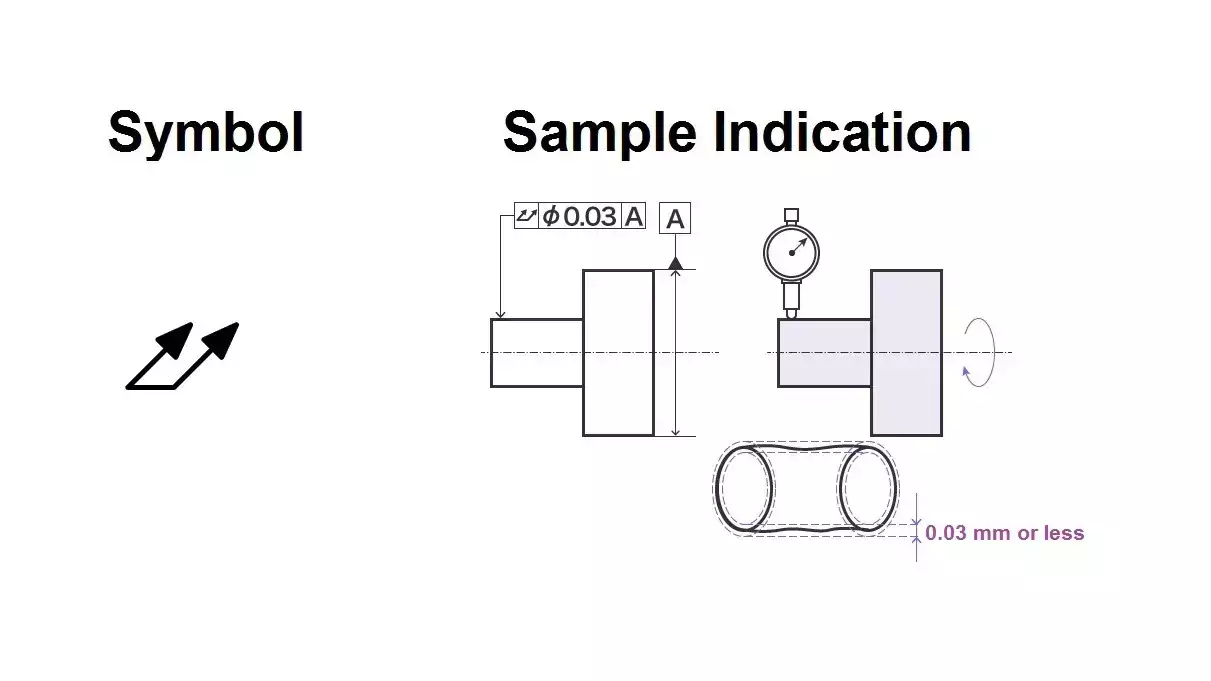
| ◯ | Circular Runout | Controls the circularity of a surface relative to a datum axis. |
| ⊕ | Position | Specifies the exact location of a feature relative to one or more datums. |
| ◊ | Profile | Controls the overall shape of a surface or line. |
| ∥ | Parallelism | Ensures a feature remains parallel to a specified datum. |
| ⊥ | Perpendicularity | Ensures a feature is perpendicular to a specified datum. |
| ⌒ | Circularity | Controls the roundness of a circular feature. |
| ~ | Flatness | Ensures a surface lies within a defined plane. |
| ≈ | Straightness | Controls the straightness of a line or axis. |
| Ⓜ | Maximum Material Condition (MMC) | Defines tolerances based on the maximum material allowed for a feature. |
| ⓛ | Least Material Condition (LMC) | Defines tolerances based on the least material allowed for a feature. |
4. Types of Tolerances in GD&T

a. Form Tolerances
Control the shape of individual features:
- Flatness
- Straightness
- Circularity
- Cylindricity
b. Orientation Tolerances
Control the angular relationship between features:
- Angularity
- Parallelism
- Perpendicularity
c. Location Tolerances
Control the position of features relative to datums:
- Position
- Symmetry
- Concentricity
d. Runout Tolerances
Control the variation of a surface around an axis:
- Circular Runout
- Total Runout
5. Benefits of Using GD&T
- Improved Quality: Ensures parts meet functional requirements, reducing defects.
- Reduced Scrap: Allows for looser tolerances on non-critical features, saving material.
- Better Assembly: Ensures parts fit together correctly during assembly.
- Global Standardization: Facilitates communication across international teams and suppliers.
6. Common GD&T Applications
- Aerospace: Critical components like turbine blades and landing gear require tight tolerances.
- Automotive: Engine components, transmission systems, and suspension parts rely on GD&T for precision.
- Medical Devices: Implants and surgical tools must meet strict dimensional and functional requirements.
- Consumer Goods: Electronics, appliances, and packaging benefit from GD&T’s ability to ensure consistency.
7. Challenges in Implementing GD&T
While GD&T offers numerous benefits, it can be challenging to implement effectively:
- Training: Requires specialized knowledge and training for engineers, designers, and inspectors.
- Complexity: The use of symbols and rules can be overwhelming for beginners.
- Software Integration: CAD/CAM systems must support GD&T standards for accurate design and manufacturing.
8. Conclusion
GD&T is an essential tool for modern manufacturing, providing a precise and standardized way to communicate design intent and functional requirements. By focusing on the geometry of parts rather than just their dimensions, GD&T ensures that products are manufactured to the highest standards of quality and performance.
If you have specific questions about GD&T symbols, applications, or implementation, feel free to ask!