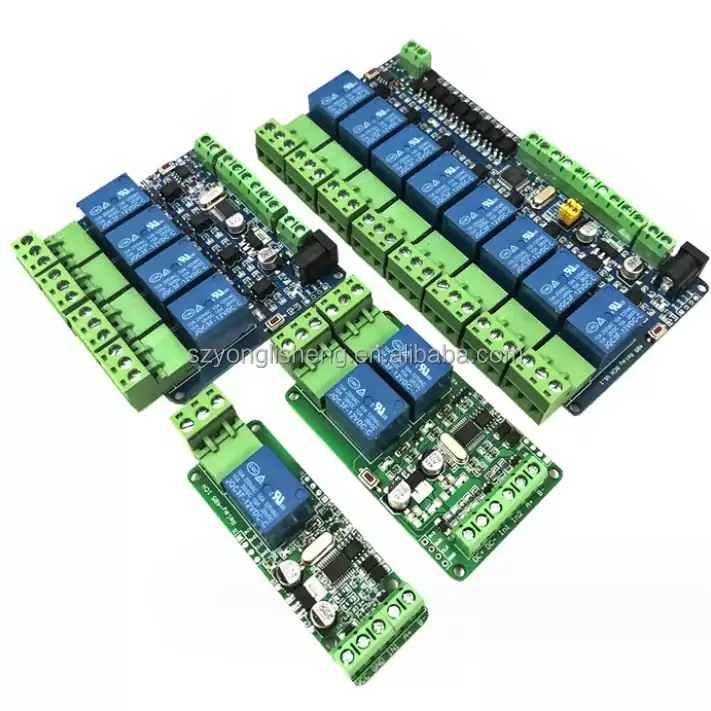
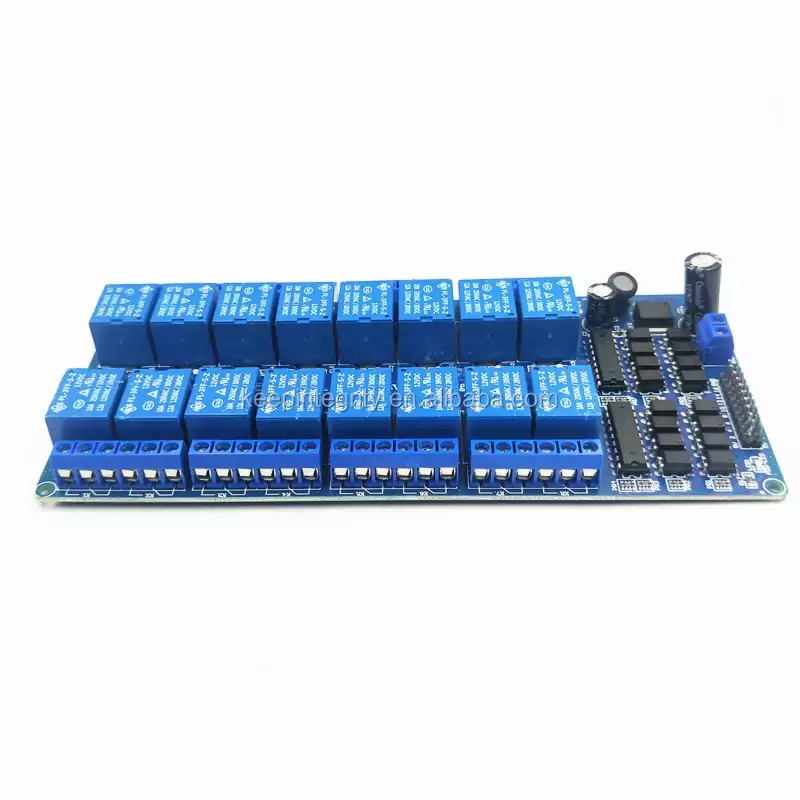
You’ve got a brilliant DIY project brewing , maybe automating your garden irrigation, building a smart lamp, or adding lights to your model railway. You’ve got your Arduino or Raspberry Pi humming along… but now you need to control something powerful: mains-powered lights, a water pump, or a heater. Directly connecting these to your tiny microcontroller? That’s a one-way trip to “smoke town” . Enter the relay board the unsung hero that safely bridges your low-voltage brain to high-voltage brawn. Let’s crack the code.
What is a Relay Board & How Does it Work?
Think of a relay as a remote-controlled switch. It uses a small, safe electrical signal (like the 5V or 3.3V output from your Arduino, GRBL controller, or Raspberry Pi) to control a much larger, potentially dangerous electrical load (like your 110V/240V spindle motor or dust collector).
- The Magic Inside: A relay board contains one or more individual relays. Each relay has:
- Coil: A small electromagnet. When your controller sends its low-voltage signal (e.g., 5V), current flows through the coil, creating a magnetic field.
- Contacts: Metal switches physically moved by the magnet. These are connected to your high-power circuit (spindle, etc.).
- The Operation: When the coil is energized (controller signal ON), the magnet pulls the contacts closed, completing the high-power circuit – your spindle spins! When the coil de-energizes (signal OFF), a spring pulls the contacts open, safely cutting power to the spindle. Crucially, the low-voltage control circuit and the high-voltage load circuit are electrically isolated. This protects your delicate $30 controller board from the harsh realities of mains voltage and motor inrush currents. Most DIY relay boards add optocouplers for even stronger isolation – a vital safety feature.
Why You Absolutely Need One (Beyond Just “On/Off”)
- Safety First: Your $5 microcontroller outputs milliamps at 5V. Your 100W lamp pulls over 0.8 Amps at 120V. Connecting them directly fries your precious brainboard. Relays provide critical electrical isolation – the high-voltage side is physically separated from your low-voltage control side. Optocouplers on good boards add an extra light-based barrier.
- Handling Heavy Loads: Microcontrollers can’t drive motors, heaters, or mains-powered devices directly. Relays handle the grunt work.
- Key DIY Applications:
- Home Automation: Turn lamps, fans, or coffee makers on/off via your phone or voice assistant.
- Garden Projects: Control solenoid valves for automatic watering systems.
- Modeling & Hobbies: Power track lighting, animated displays, or fog machines in model railroads/dioramas.
- Prototyping: Safely test high-power circuits without risking your main controller.
- Laser Power Supply (for diode lasers): While some low-power diodes use PWM directly, higher-power systems often need relay control for the main power.
- Workshop Helpers: Switch dust collectors, bench lights, or air compressors alongside your tools.
- Spindle On/Off: The #1 application. Your spindle (router, spindle motor) runs on mains voltage (110V/240V AC). The relay acts as the master switch, triggered by your G-code (M3/M4/M5 commands).
- Coolant Pump: If using flood coolant, the pump often needs mains power switching.
- Dust Collection: Syncing your vacuum or dust collector to spindle operation is essential for a clean shop and machine longevity. The relay turns it on/off with the spindle.
- Auxiliary Lighting: Powerful shop lights mounted on the gantry.
Choosing the RIGHT Relay: Sizing is Everything (Don’t Guess!)
Picking the wrong relay leads to melted plastic, fried controllers, or fire hazards. Follow these steps:
- Match the Control Voltage (NON-NEGOTIABLE):
- Check your microcontroller’s output voltage (e.g., Arduino Uno: 5V, Raspberry Pi GPIO: 3.3V).
- BUY A RELAY BOARD EXPLICITLY LABELED FOR THAT VOLTAGE. A “5V Relay Board” won’t reliably switch with a 3.3V Pi signal. A “3.3V Relay” connected to 5V will overheat and fail.
- Size the Contact Rating (The MOST Critical Step):
- Find Your Load’s Current (Amps): Look at the device’s label or manual. It will say something like “120V ~ 60W” or “240V AC 2A”.
- Calculate Amps: Amps (A) = Watts (W) / Volts (V). E.g., a 100W lamp on 120V: 100W / 120V = 0.83A.
- Respect the Inrush Current (Especially for Motors/Lights): When devices like pumps, compressors, or incandescent bulbs start, they can draw 5-10x their normal current for a split second. A relay rated only for the running current (e.g., 1A) will weld its contacts shut trying to handle a 5A+ inrush.
- The Golden Rule:Choose a relay contact rating at least 50-100% HIGHER than the running current, and ensure it handles the inrush for motors/transformers.
- Example: A small 50W 12V DC water pump (common in hydroponics) draws ~4.2A running. Pick a relay rated for at least 8-10A DC. For a 100W 120V AC lamp (0.83A), a 5A or 10A AC relay is safe (handles the bulb’s inrush). For mains AC devices (120V/240V), ALWAYS choose a relay rated for at least 250V AC. Never use a 120V relay on 240V!
- Find Your Load’s Current (Amps): Look at the device’s label or manual. It will say something like “120V ~ 60W” or “240V AC 2A”.
- Check the Contact Type:
- SPDT (Single Pole Double Throw) is most common. You’ll use the NO (Normally Open) contact for standard “off until activated” control (e.g., turning a lamp on). Avoid NC (Normally Closed) for safety-critical “on” functions.
- Must-Have Features for Hobbyists:
- Optoisolation: Non-negotiable for safety and noise immunity. Look for the little optocoupler chip (like PC817) on the board.
- Flyback Diode: Protects your microcontroller from voltage spikes when the relay turns off (usually built-in).
- Status LEDs: Incredibly helpful for debugging – shows when the relay is activated.
- Clear Labeling: Terminals marked “IN,” “VCC,” “GND,” “COM,” “NO,” “NC.”
Safety is NOT Optional
- ALWAYS disconnect mains power before wiring high-voltage connections.
- Use wire gauges appropriate for the current (e.g., 18 AWG for <10A).
- Secure all terminal screws tightly – vibration loosens them!
- Mount the relay board securely, away from water, heat, and moving parts.
- When in doubt, consult an electrician. Mains voltage can kill.
The Takeaway
Relay boards aren’t just convenient; they’re the essential, safe gateway between your creative low-voltage projects and the powerful real world. By matching the control voltage, carefully sizing the contact rating for both running and inrush current, and insisting on optoisolation, you unlock a universe of DIY possibilities without risking your gear or your safety. Ditch the duct tape and direct wiring – grab the right relay board, and switch on your next big idea with confidence!