
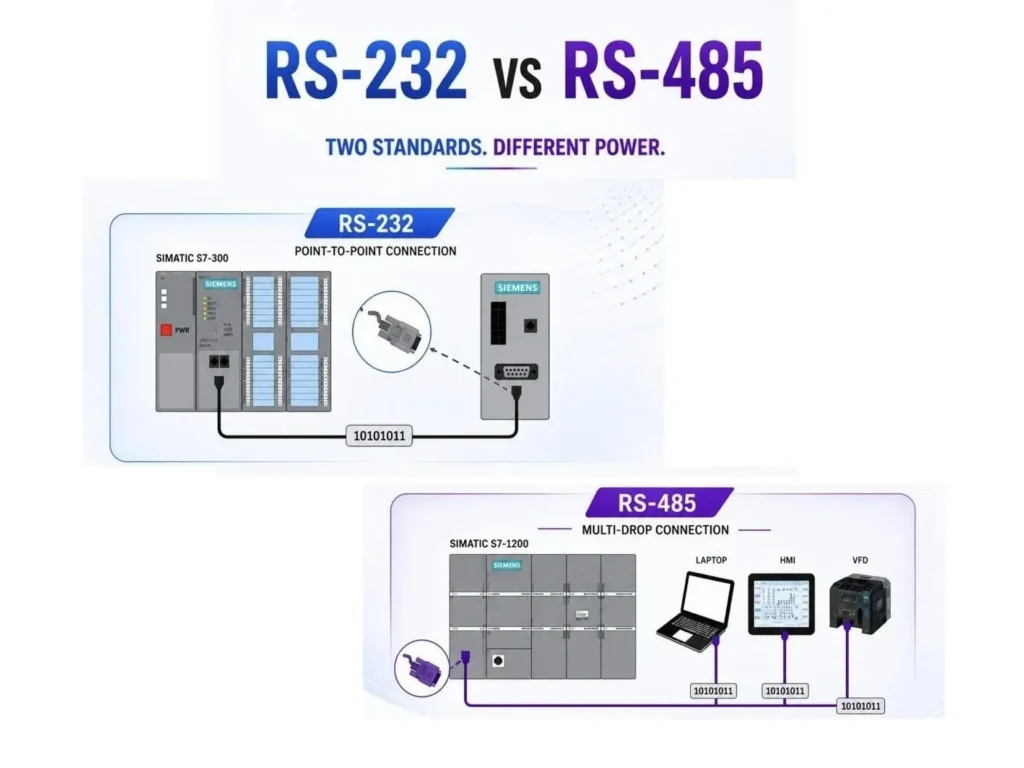
In the fast-paced world of industrial automation, reliable communication between devices is the absolute backbone of any successful operation. Today, it is easy to get caught up in the hype surrounding Industrial Ethernet protocols like PROFINET, EtherNet/IP, and EtherCAT. However, despite the massive rise of high-speed Ethernet, two legacy serial communication standards RS232 and RS485 remain incredibly relevant and widely used.
From connecting Programmable Logic Controllers (PLCs) and Human-Machine Interfaces (HMIs) to integrating sensors, variable frequency drives (VFDs), and complex instrumentation, serial communication is still the unsung hero of the factory floor.
But when designing or troubleshooting an automation system, how do you choose between the two? What actually makes RS232 and RS485 different under the hood? Let’s dive deep into the technical nuances, applications, and best practices of these two industrial workhorses.
RS232: The Reliable Veteran
Introduced in the 1960s, RS232 is the grandfather of serial communication. While it may seem ancient by modern tech standards, its simplicity ensures it remains a staple in industrial environments today.
The Technical Profile:
- Distance Limitations: RS232 is strictly designed for short-distance communication, typically maxing out at 15 meters (50 feet). Beyond this, signal degradation due to cable capacitance becomes unmanageable.
- Topology: It supports only point-to-point communication. This means it connects exactly one transmitter to one receiver. You cannot daisy-chain multiple devices on a single RS232 line.
- Signaling Method: RS232 uses single-ended signaling. This means the signal voltage is measured relative to a common ground wire. While simple, this makes the standard highly susceptible to electrical noise and electromagnetic interference (EMI). If ground potentials shift between devices, data corruption is almost guaranteed.
- Speed and Duplex: It supports full-duplex communication, meaning data can be sent and received simultaneously over separate wires. Common operating speeds reach up to 115.2 kbps. While higher speeds are technically possible over very short distances, 115.2 kbps is the reliable industry standard.
Typical Applications:
Because of its short-range, point-to-point nature, RS232 is rarely used for plant-wide networking today. Instead, it is the go-to standard for:
- PLC and HMI Programming Ports: Connecting a laptop directly to a controller for initial configuration.
- Legacy Automation Equipment: Interfacing with older CNC machines and manufacturing cells.
- Peripheral Devices: Connecting barcode scanners, simple industrial instruments, and serial modems directly to a host PC or controller.
RS485: The Industrial Workhorse
If RS232 is the reliable veteran, RS485 is the rugged, long-distance workhorse built specifically for the harsh realities of the industrial environment.
The Technical Profile:
- Distance and Scale: RS485 is designed for long-distance communication, capable of running up to 1200 meters (4000 ft). Furthermore, it supports multi-drop (or multi-point) communication, allowing up to 32, 128, or even 256 devices (depending on the transceiver) to share the exact same communication bus.
- Signaling Method: This is RS485’s superpower. It uses differential signaling. Instead of referencing a signal to a common ground, RS485 uses two wires and measures the voltage difference between them. Because electrical noise (EMI) tends to affect both wires equally, the receiver simply ignores the noise and reads only the difference. This provides excellent immunity to electrical interference.
- Speed: RS485 can support blistering data rates up to 10 Mbps over very short distances. However, as the cable length increases toward the 1200m maximum, the speed must be proportionally reduced to maintain signal integrity.
- Duplex: Standard RS485 is half-duplex (using two wires for both sending and receiving, taking turns). A 4-wire variant exists for full-duplex, but 2-wire half-duplex is the industry standard for multi-drop buses.
Common Protocols:
It is crucial to understand that RS485 is merely a physical layer standard—it defines the voltages and wiring. The actual “language” the devices speak is defined by the protocol running on top of it. Common protocols utilizing the RS485 physical layer include:
- Modbus RTU: The undisputed king of industrial serial communication.
- BACnet MS/TP: Widely used in building automation and HVAC control.
- Profibus DP: A staple in European manufacturing and process control.
Head-to-Head: Key Differences Summarized
To make the decision-making process easier, here is a direct comparison of the two standards:
- Distance: RS232 is limited to 15 m, while RS485 can stretch up to 1200 m.
- Network Topology: RS232 is strictly point-to-point (1-to-1). RS485 is multi-drop/multi-point (1-to-many).
- Noise Immunity: RS232 has moderate immunity due to single-ended signaling. RS485 has excellent immunity due to differential signaling.
- Typical Applications: RS232 is best for local device configuration, programming, and legacy point-to-point equipment. RS485 is the standard for industrial communication networks, SCADA systems, and distributed field devices.
RS485 Best Practices for Flawless Communication
Deploying RS485 is not as simple as just twisting two wires together. Because it is often run through electrically noisy industrial environments, proper installation is critical. Follow these best practices to ensure bulletproof communication:
1. Always Use Twisted-Pair Cable
The physical twisting of the wires ensures that both conductors are exposed to the exact same electromagnetic fields. This is what allows the differential receiver to cancel out the noise. Never use parallel or untwisted wires for an RS485 bus.
2. Install 120 Ω Termination Resistors
When high-speed digital signals hit the end of a cable, they can bounce back (reflect) and corrupt the data. To prevent this, you must install a 120-ohm termination resistor at both physical ends of the RS485 bus. Do not put resistors on devices in the middle of the line.
3. Use Biasing Resistors When Required
When no device is actively transmitting, the RS485 bus is in an “idle” state. If the line is left floating, electrical noise can trick the receivers into thinking data is being sent, causing framing errors. Biasing resistors (pull-up and pull-down) ensure the bus rests in a defined, known idle state.
4. Avoid Star Topologies; Use Daisy-Chains
RS485 requires a linear bus topology (daisy-chaining). If you use a “star” topology (running a separate short cable from a central hub to each device), those short cables act as “stubs.” Stubs cause severe signal reflections that will crash your network. Always wire devices in a continuous line.
5. Utilize RS485 Repeaters for Long Runs
If your network design requires exceeding the 1200-meter limit, or if you need to branch the network (which requires isolating segments), use dedicated RS485 repeaters. They regenerate the signal, allowing you to extend the network indefinitely.
6. Consider Fiber Optic Converters for High-EMI Zones
If your RS485 cable must run through areas with extreme electromagnetic interference (such as directly alongside high-voltage lines or massive VFDs), copper cable may fail. In these cases, use RS485-to-fiber optic converters. Fiber is completely immune to EMI and can span for kilometers.
Why RS485 Continues to Dominate Industrial Automation
Given the availability of Industrial Ethernet, why do engineers still specify RS485 by the millions of nodes every year? The answer lies in its unique blend of practical benefits:
- Cost-Effective Scalability: It allows you to connect dozens of devices on a single, inexpensive two-wire cable, drastically reducing wiring complexity, panel space, and installation labor costs compared to running individual analog wires or expensive Ethernet switches to every field device.
- Unmatched Reliability: Its differential signaling makes it incredibly robust in harsh, electrically noisy environments where Ethernet might struggle without expensive shielding.
- Long-Distance Reach: It easily bridges the gap between distant subpanels and main control rooms without needing network switches or repeaters.
- Universal Protocol Support: Because it is the physical foundation for Modbus RTU, the most universally supported serial protocol in the industry, RS485 guarantees compatibility with almost every piece of industrial equipment on the market.
Final Thoughts
Choosing the right communication standard is critical for building reliable, scalable, and efficient automation systems. While Industrial Ethernet is undoubtedly the future for high-bandwidth, data-heavy applications, RS232 and RS485 remain vital tools in the automation engineer’s toolkit.
Use RS232 for simple, short-range, point-to-point configuration tasks. But when you need to build a robust, noise-immune, multi-device network across a sprawling facility, RS485 remains the undisputed champion of the factory floor.
What is your experience with serial communication on the plant floor? Have you successfully migrated legacy RS485 networks to Ethernet, or do you still rely on serial for critical processes? Let us know in the comments below!


