
Whether you’re a seasoned machinist or just getting started with turning, one universal truth remains: your work is only as good as its foundation. In the world of lathes, that foundation is your work holding device. The right device ensures accuracy, stability, and, most importantly, safety while the spindle is turning.
But with so many options from the familiar three-jaw chuck to specialized collets and rests how do you choose? Let’s dive into the core types of lathe holding devices and when to use them.
Chucks: The universal grippers
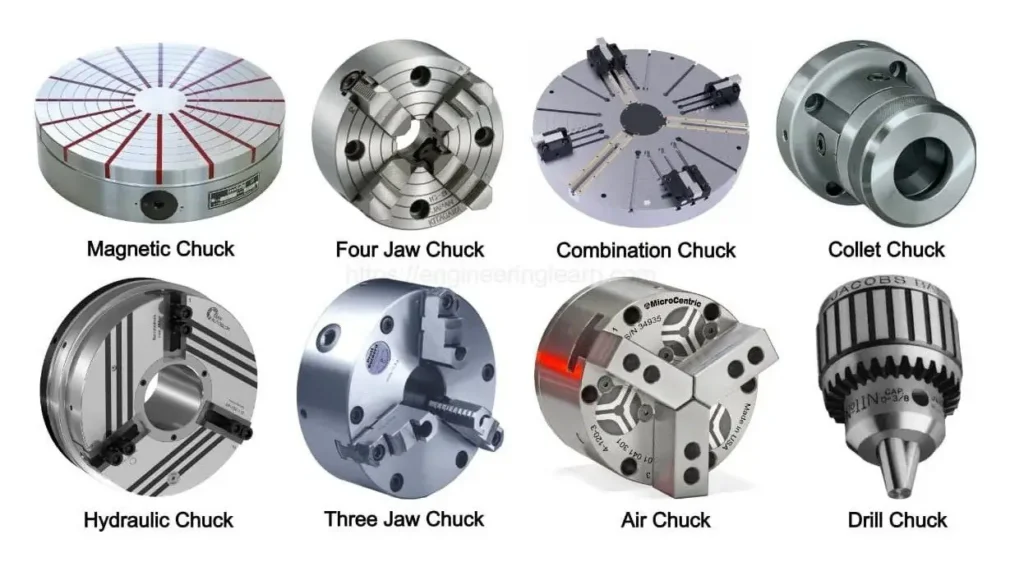
Chucks are the workhorses of the lathe. Mounted on the headstock, they use jaws to clamp and rotate the workpiece.

- Three-jaw (Self-Centering) Chucks:
- Best for: Round or hexagonal stock. All three jaws move in unison, making setup extremely fast and simple for symmetrical work.
- The Catch: While quick, they are less accurate than independent chucks. They are also prone to wear and tear, which can reduce their precision over time.

- Four-jaw (Independent) Chucks:
- Best for: Irregularly shaped workpieces, square stock, and precision work. Each jaw can be adjusted independently, allowing you to perfectly center a piece or intentionally hold it off-center for eccentric turning.
- The Catch: Setup can take significantly longer than with a three-jaw chuck, as each jaw must be adjusted and indicated.
- Magnetic Chucks:
- Best for: Holding delicate, thin, or easily deformed workpieces. Using a magnetic field to clamp the piece, these chucks prevent marring and distortion from mechanical jaws.
- The Catch: Only works with ferromagnetic materials and is not suitable for heavy cuts that could overcome the magnetic force.
Collets: For maximum precision
When your project demands the highest level of concentricity and a firm, even grip, you turn to collets. These are especially useful for repetitive, high-speed work.
- How They Work: A collet is a slotted sleeve that fits inside a collet chuck. As a drawbar pulls the collet inward, the tapers compress the sleeve, providing a uniform, 360-degree clamping force on the workpiece.
- Best for: Small-diameter bar stock and parts requiring extreme precision. Collets offer superior accuracy and repeatability compared to standard chucks.
- The Catch: Each collet holds a specific diameter or a very small range of diameters. This means you need a dedicated collet for each size, unlike a chuck that can hold a wider range.
Faceplates: For the oddly shaped
For workpieces that are too large or too irregularly shaped to be held by a standard chuck, the faceplate is the answer.
- How They Work: A faceplate is a flat, slotted disc that screws onto the headstock spindle. The workpiece is secured to the faceplate using nuts, bolts, and clamps.
- Best for: Large or oddly shaped items that need to be turned. You can also add counterweights to the faceplate to balance eccentric work, preventing excessive vibration.
- Pro Tip: Mounting is a careful process. For complex shapes, some machinists use a sacrificial faceplate (often made from plywood) that they can drill into for easier mounting.
Centers and mandrels: The supportive foundation
These devices are primarily used for holding long workpieces between the headstock and tailstock.
- Live vs. Dead Centers: A live center, used in the tailstock, rotates with the workpiece to prevent friction and heat buildup. A dead center, typically mounted in the headstock, remains stationary and requires lubrication.
- Mandrels: Used for holding hollow, cylindrical workpieces from the inside. The mandrel is held between centers, and the workpiece is mounted on it, allowing the outer surface to be machined.
Steady and Follower Rests: The extended arm of support
Turning long, slender workpieces can cause them to bend or “whip” under the pressure of the cutting tool. Rests provide crucial support.
- Steady Rests: These are bolted to the lathe’s bed and remain stationary. They provide rigid support for a workpiece and allow you to machine its end without tailstock interference.
- Follower Rests: Attached to and traveling with the lathe’s carriage, follower rests support the workpiece directly behind the cutting tool. This is ideal for threading long shafts or taking finishing passes.
Final thoughts
Choosing the right holding device is a critical decision that affects the outcome of your turning project. By understanding the applications and limitations of each tool, you can select the right option to ensure your work is always secure, accurate, and ready for a perfect finish.


