

Threading is one of the most common operations performed on CNC lathes. Whether you’re cutting external or internal threads, using a threading cycle helps automate the process, reduce programming time, and ensure consistent thread quality. In this blog post, we’ll explore what a threading cycle is and provide syntax examples for three of the most widely used CNC control systems:
- Fanuc
- Siemens (Sinumerik)
- Heidenhain
What Is a Threading Cycle?
A threading cycle is a canned cycle that automates the motion required to cut a thread. It allows the programmer to define key parameters such as:
- Thread pitch (F)
- Depth of cut (P)
- Number of passes
- Start and end positions (X,Z)
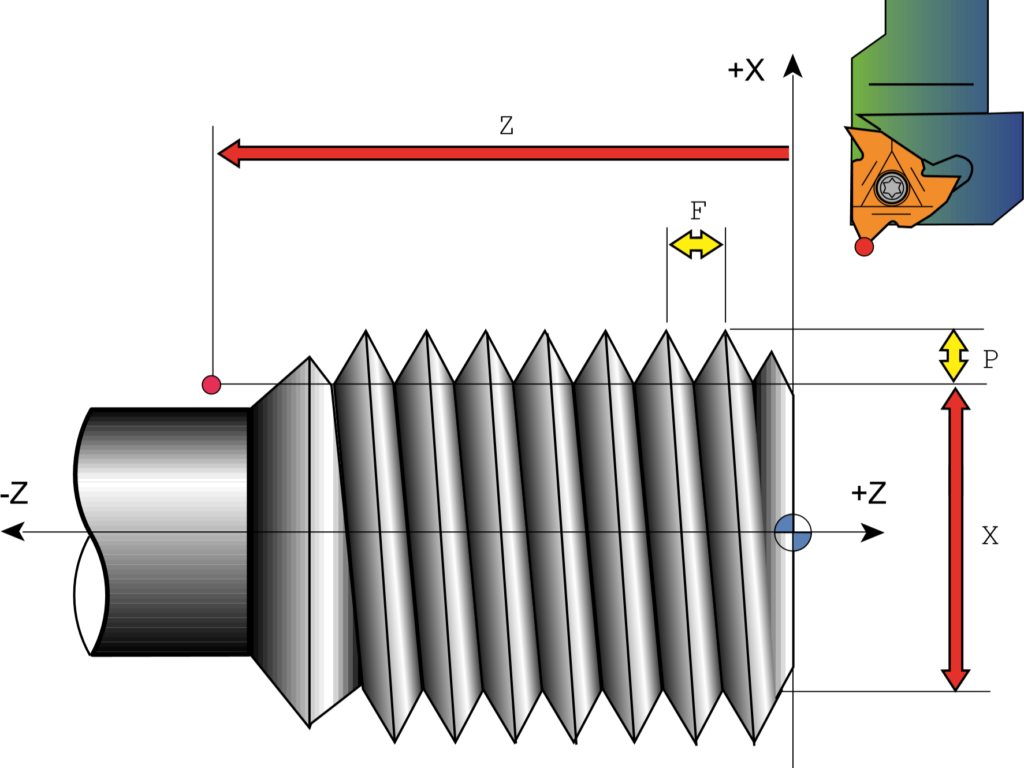
Instead of manually writing each pass with G-code, a single line (or block) of code can initiate the entire threading operation.
1. Fanuc Control – G92 Threading Cycle
Fanuc controls are widely used in the industry, especially in Asia and North America. The G92 command is commonly used for simple straight threading cycles.
Syntax:
G92 X(U)__ Z(W)__ F__ ;XorU: Final thread diameter (absolute/incremental)ZorW: End position along the Z-axisF: Thread pitch (feed per revolution)
Example – External Thread Cutting:
G97 S500 M03 ;        (Constant spindle speed)
G00 X30.0 Z2.0 ;      (Rapid move to start point)
G92 X28.5 Z-20.0 F1.5 ; (First threading pass)
X28.0              ; Second pass
X27.6              ; Third pass
X27.4              ; Final pass
G00 X100.0 Z100.0 ;   (Retract tool)
M30 ;               (End program)
Tip: Multiple passes are programmed by changing only the
Xvalue while keepingZ,F, and other parameters the same.
2. Siemens Sinumerik – CYCLE97 for Threading cycle
Siemens Sinumerik controls are popular in Europe and use more descriptive commands. The CYCLE97 function is used for longitudinal threading.
Syntax:
CYCLE97 (PTP, PITCH, THREAD_DEPTH, FIRST_CUT_DEPTH, ANGLE, ...)Example – Internal Thread Cutting:
M03 S600 ;                (Spindle on clockwise)
G00 X16.0 Z2.0 ;          (Position to start point)
CYCLE97 (Z-20, 1.5, 0.9, 0.3, 60) ;
; Parameters:
; Z-20 = Thread length
; 1.5 = Pitch
; 0.9 = Total thread depth
; 0.3 = First cut depth
; 60 = Thread angle
G00 X100 Z100 ;          (Retract)
M30 ;                    (Program end)
Note: Siemens often uses modal drilling/turning cycles that handle multiple passes automatically based on parameters.
3. Heidenhain – L93 for Threading cycle
Heidenhain controls are known for their conversational programming interface but also support standard G-code. The L93 subroutine is typically used for threading operations.
Syntax (in conversational mode):
THREADING
Thread Diameter: ___
Thread Length: ___
Pitch: ___
Start Position Z: ___
Number of Passes: ___
Example – G-code Equivalent:
BLK FORM 0.1 Z+0 ;     (Workpiece definition)
TOOL CALL 1 Z S3000 ;  (Tool selection and spindle speed)
L93 X30 Z-20 F1.5 A60 ; (Threading cycle)
; Where:
; X = Major diameter
; Z = Thread length
; F = Pitch
; A = Thread angle
M30 ;                  (End of program)
Tip: Heidenhain’s L93 handles both internal and external threads depending on how X is defined.
Comparison Summary
| Feature | Fanuc (G92) | Siemens (CYCLE97) | Heidenhain (L93) |
|---|---|---|---|
| Command Type | Modal G-code | Canned cycle | Subroutine / Conversational |
| Pitch Input | F parameter | Parameter list | F parameter |
| Thread Angle | Manual setup | Defined in parameters | A parameter |
| Multiple Passes | Repeat line with X | Built-in logic | Predefined number of passes |
| Ease of Use | Simple, manual | Flexible, automated | Very user-friendly |
Conclusion
Understanding how to use threading cycles across different CNC control systems is essential for efficient machining. While the basic concept remains the same , cutting threads with multiple passes , the way you input data varies significantly between Fanuc, Siemens, and Heidenhain.
Whether you’re working with G-code or a conversational interface, mastering these cycles will save you time, reduce errors, and improve the quality of your threaded parts.
Want More?
If you found this helpful, check out our other posts on:
Stay tuned for more tips and tutorials on CNC programming and machining best practices!


